


Marketing often feels like a gamble. You pour time into social media, money into ads, and energy into bridal shows, crossing your fingers that the phone will ring. But as an experienced travel professional, relying on "hope" is not a strategy. To truly scale your agency, you must treat marketing as the lifeblood of your business—a lever that allows you to grow predictably rather than accidentally. The difference between a struggling agent and a profitable CEO isn't just about how well they sell travel; it is about how well they measure their money. It is time to stop obsessing over vanity metrics like "likes" and start obsessing over your return on investment.

The Trap of Vanity Metrics
In the age of digital dominance, it is easy to get distracted by social media engagement. Getting page likes or heart reactions feels good, but it does not always equate to immediate leads or sales. A post with 500 likes that generates zero inquiries is a cost, not an investment. To determine if your marketing is actually working, you need to look past the "buzz" and look at the math.
We recommend tracking two critical Key Performance Indicators (KPIs): Cost Per Inquiry (CPI) and Cost Per Conversion (CPC).
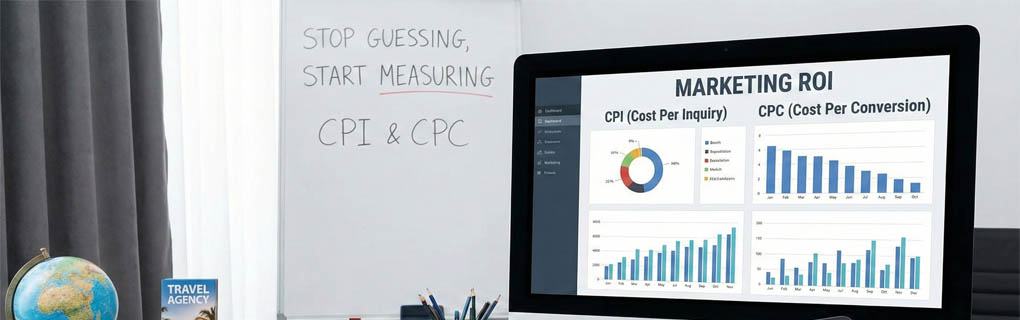
Metric 1: Cost Per Inquiry (CPI)
Your CPI answers the question: How much does it cost to get someone to raise their hand?
This is calculated by taking your total marketing spend for a specific channel and dividing it by the number of inquiries you received.
Formula: Total Spend / # of Inquiries = CPI
For example, if you spend $500 a month on marketing and receive 33 legitimate inquiries, your CPI is $15.15.
For a brand-new marketing channel or a new business, your goal should be to keep this under $50 per inquiry. However, as you refine your targeting and brand consistency, an experienced agent should aim to drive this number down to under $20. If your CPI is too high, your messaging isn't resonating, or you are fishing in the wrong lake.

Metric 2: Cost Per Conversion (CPC)
Here is where the data gets interesting. A low CPI is great, but it is worthless if those inquiries don't turn into paychecks. Your Cost Per Conversion (sometimes called Cost Per Booking) tells you how much you spent to actually acquire a paying client.
Formula: Marketing Spend / # of Booked Clients = CPC
This metric is the ultimate truth-teller. It helps you identify which marketing channels bring you "tire kickers" and which bring you serious travelers.
Become a Travel Agent: Unleash Your Full Potential
Ready for a career that's as fulfilling as it is rewarding? Becoming a travel agent with Vincent Vacations means building a business around your passion for travel.

The "Aha!" Moment: A Case Study
Let’s look at a scenario that proves why you need to measure both. Imagine you tested two marketing strategies last month: Direct Mail and a Community Event.
-
Strategy A (Direct Mail): You spent $100. You received only 4 inquiries.
CPI: $25.00 per inquiry. -
Strategy B (Community Event): You spent $100. You received 10 inquiries.
CPI: $10.00 per inquiry.
If you only looked at CPI, the Community Event looks like the winner. It generated more buzz and cheaper leads. But let’s look at the conversions.
-
Strategy A (Direct Mail): Of those 4 inquiries, 2 people booked a trip.
CPC: $50.00 to acquire a customer. -
Strategy B (Community Event): Of those 10 inquiries, only 1 person booked.
CPC: $100.00 to acquire a customer.
The Verdict: The "expensive" Direct Mail leads were actually twice as profitable as the "cheap" Event leads. The Direct Mail audience was more qualified and ready to buy, while the Event audience was likely just browsing. Without tracking CPC, you might have doubled your budget for the event and lost money in the long run.

Patience Pays Off
One final rule for the data-driven agent: The 90-Day Rule.
Marketing requires consistency. We know that a client often needs to see your message at least seven times (The Rule of 7) before they trust you enough to buy. Therefore, you cannot perform a detailed analysis if you change your strategy every week. Build your plan and stick with it for a minimum of 90 days before analyzing or making changes. If you shift too often, you skew your data and lose the ability to see what is truly working.

Partner with a Host Who Understands Business
At Vincent Vacations, we don't just teach you how to book travel; we teach you how to build a profitable enterprise. We provide the tools to track these KPIs because we know that when you stop guessing and start measuring, you gain the clarity needed to scale to 6-figures and beyond.
Are you ready to treat your agency like the business it is? Join us, and let's grow your bottom line together.