KE
Karen Lee Elder
Certified Small Group Adventure & Expedition Specialist • Vincent Vacations
“Travel, truly, is an amazing privilege. Sometimes we need to travel in order to radically disrupt our lives, change our perspectives, and renew our sense of wonder. For quite a while, I believed that Mongolia would do all of that for me. This year, I finally set aside my excuses and booked G Adventures’ National Geographic Journeys: Discover Mongolia tour. It was everything I hoped it would be—and so very much more.”
The National Geographic Journeys Difference in Mongolia
According to G Adventures, their National Geographic Journeys tours provide greater exploration, insider access, and the freedom to roam without sacrificing comfort. They classify the Service Level as Upgraded, with significantly more inclusions than standard small-group tours: most meals, all entrance fees, and all excursions are covered.
Like all G Adventures departures, group sizes are intentionally intimate—averaging 12 and capped at a maximum of 14 travelers. Our group consisted of 14 guests (half from the United States). Paired with our Chief Experience Officer (CEO) and five local drivers in a fleet of four-wheel-drive vehicles, our expedition formed a tight-knit contingent of 20.
Crucially, this tour holds a Ripple Score of 100%. G Adventures assesses every tour with this transparent metric: a Ripple Score of 100 means that 100% of the money spent on land arrangements stays directly within local Mongolian businesses, family-run ger camps, community guides, and regional service providers.
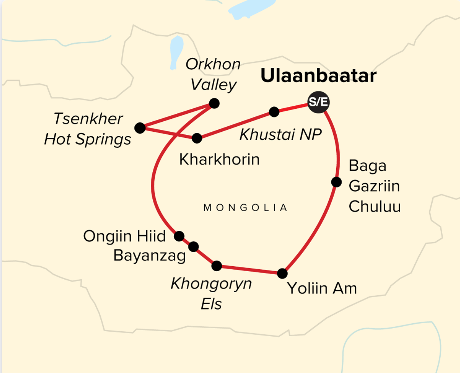
The 14-day Discover Mongolia overland expedition route, bridging central steppe historical capitals with southern Gobi Desert canyon landscapes.
Day 1 – 2
Ulaanbaatar: Monasteries, Dinosaurs, and Social Enterprise
I always recommend arriving a day early before an expedition like this to safeguard against flight delays or luggage issues, and to recover after 15+ hours in transit from Los Angeles. Ulaanbaatar is home to nearly half of Mongolia’s population (just under 2 million people). While compact, its bustling downtown traffic rivals any world metropolis.
Staying along Chinggis Avenue placed our hotel within easy walking distance of Sukhbaatar Square, the Parliament Building, and the National Museum of Mongolia. We were treated to a vibrant street festival surrounding the annual Ulaanbaatar Marathon before our evening Welcome Meeting with our CEO.
Our first full day in Ulaanbaatar explored the nation’s deep cultural and spiritual foundations. We began at Gandan Monastery, one of Mongolia’s most sacred Buddhist sites that has operated continuously for over 200 years despite the communist purges. We toured the Winter Palace of Bogd Khan—the preserved residence of Mongolia’s eighth Living Buddha and last king.
At the hilltop Zaisan Memorial, commemorating Soviet and Mongolian soldiers lost in World War II, we climbed up to take in panoramic views sweeping across the entire capital basin. Starting from the base involves 612 steps, but entering from the top floor of the upscale Zaisan Hill Complex cuts that ascent in half to 300 steps!
For lunch, our group visited the Planeterra-supported No Limits Café. This inspiring social enterprise supports children with Down syndrome and their families, providing vocational training that empowers young adults into independent employment. We rounded out the afternoon at the Natural History Museum of Mongolia, marveling at the towering skeleton of Tarbosaurus bataar—a fierce Asian relative of T. rex discovered right here in the Gobi Desert.
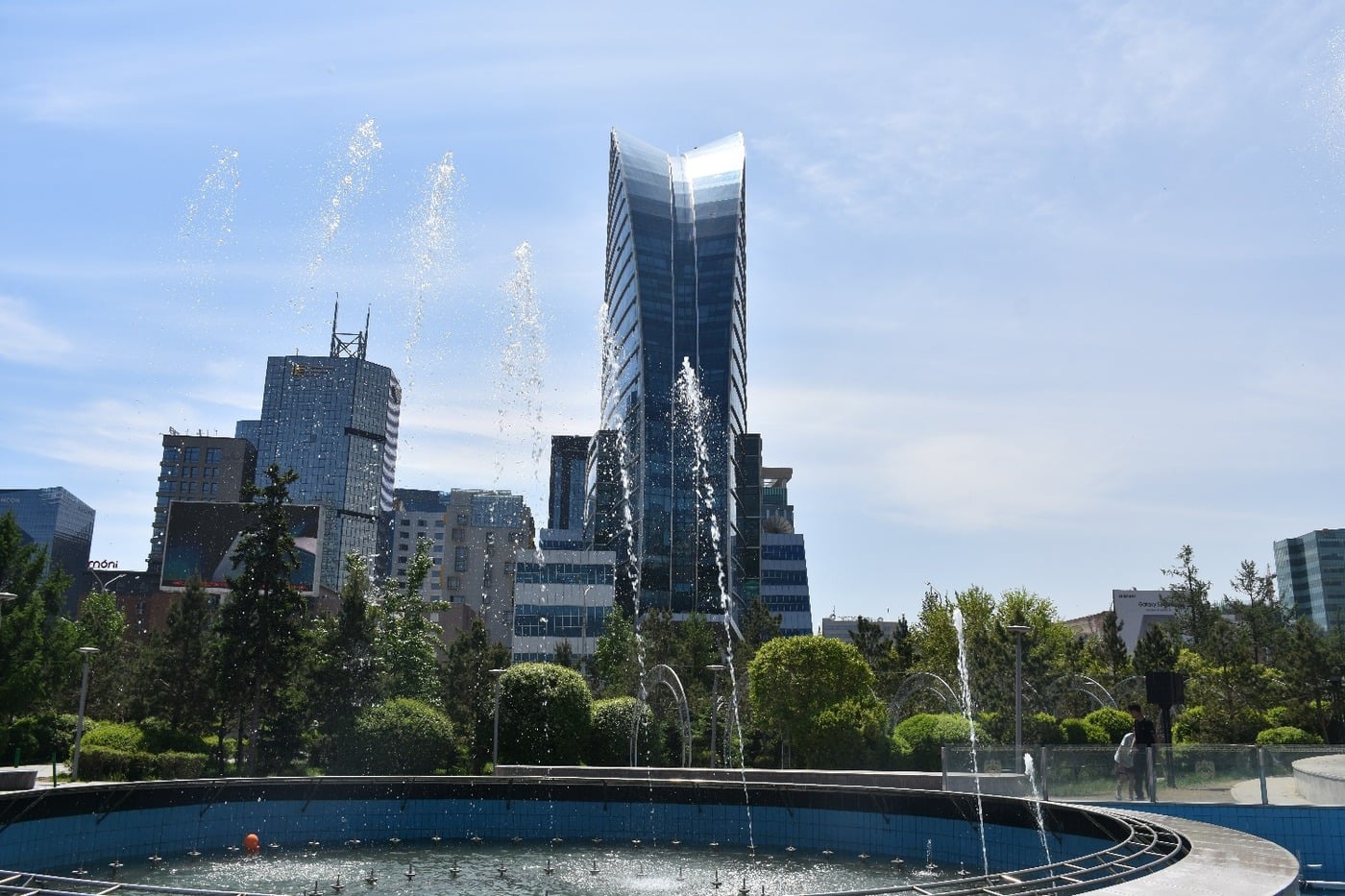
Panoramic vistas over Ulaanbaatar from the Zaisan Memorial hilltop.
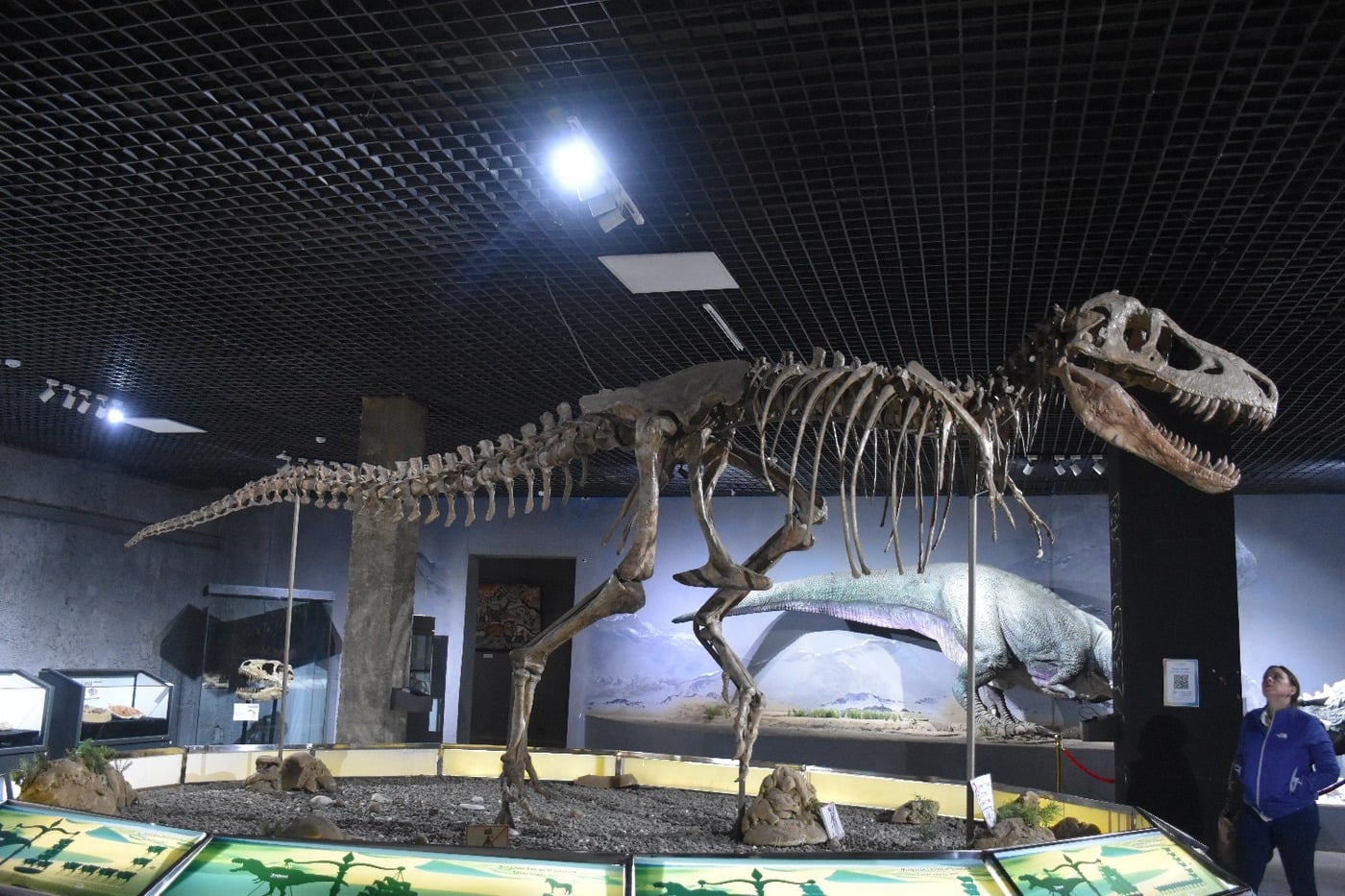
Fossilized Tarbosaurus bataar skeleton excavated from the Gobi Desert.
Day 3
Venturing into the Steppe: Hustai National Park & The Takhi
The real expedition began the next morning. After exchanging currency for Mongolian Tugrik at a bank (banks or the airport are required for non-USD currencies), we met our five drivers and loaded up our four-wheel-drive convoy. With five vehicles for 14 travelers, there were just three guests per car—guaranteeing everyone a prime window seat. We shuffled vehicles and seat partners daily, building wonderful camaraderie across the entire group.
After stocking up on bottled water and travel snacks at an open-air market, we set off into the countryside toward our first traditional Ger Camp. Gers are traditional Mongolian yurts. Each ger in our camps featured proper beds, hand-painted wooden furniture, and cast-iron wood stoves for heat during crisp nights (night temperatures dipped to 39–43°F, while daytime highs reached the upper 60s). Camp facilities included running water, flush toilets, hot showers, and dedicated dining gers where hearty meals were served.
That afternoon brought us to Hustai National Park, celebrated worldwide for the successful reintroduction of the Takhi (Przewalski’s Horse)—the world’s only remaining truly wild horse species. Genetically distinct from domestic horses, Takhi carry 66 chromosomes rather than 64. We were exceptionally fortunate to spot multiple herds grazing at remarkably close range across the grassy hillsides, and paused to examine ancient Turkic burial grounds with upright stone men anthropomorphic monuments.
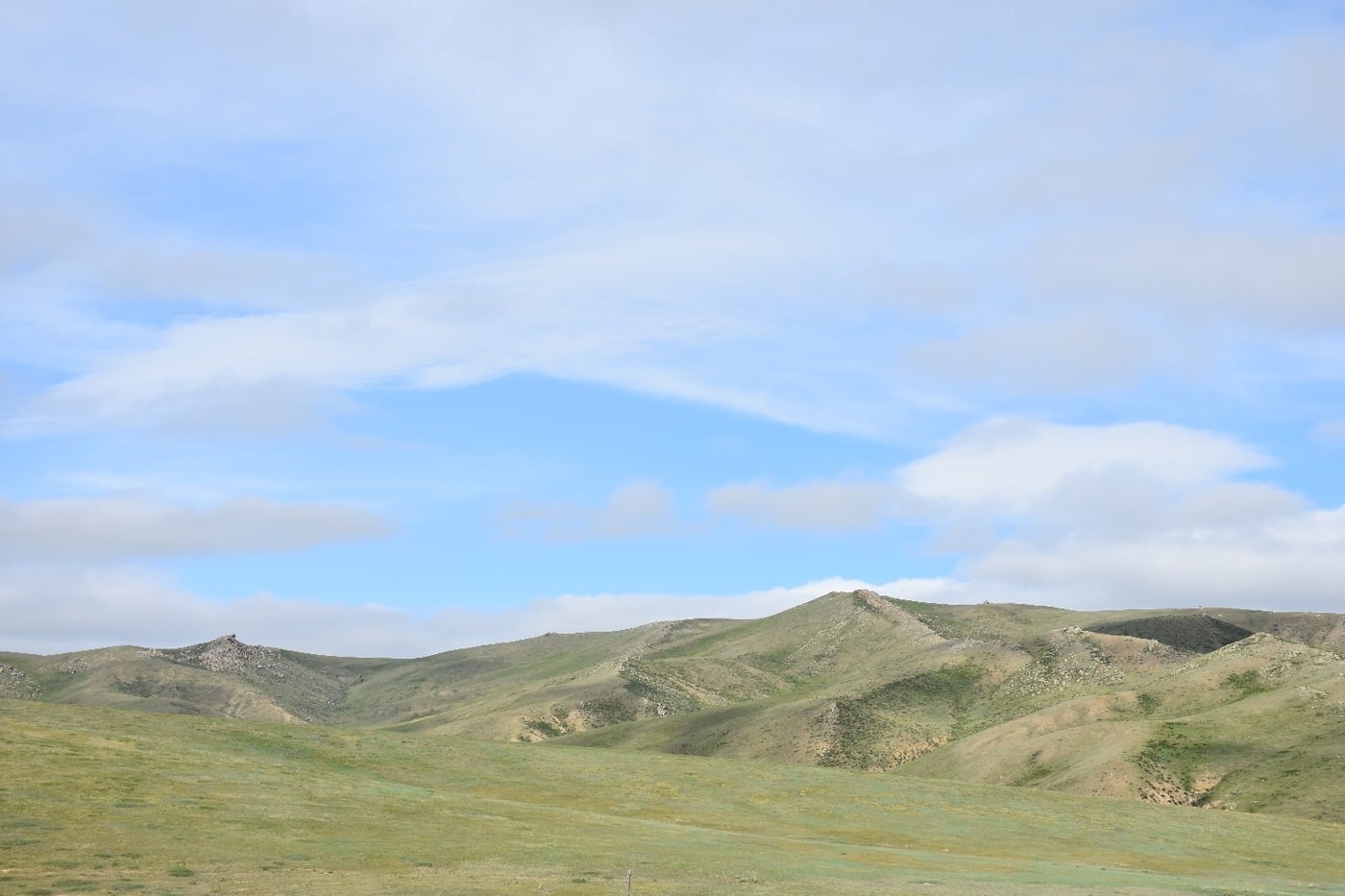
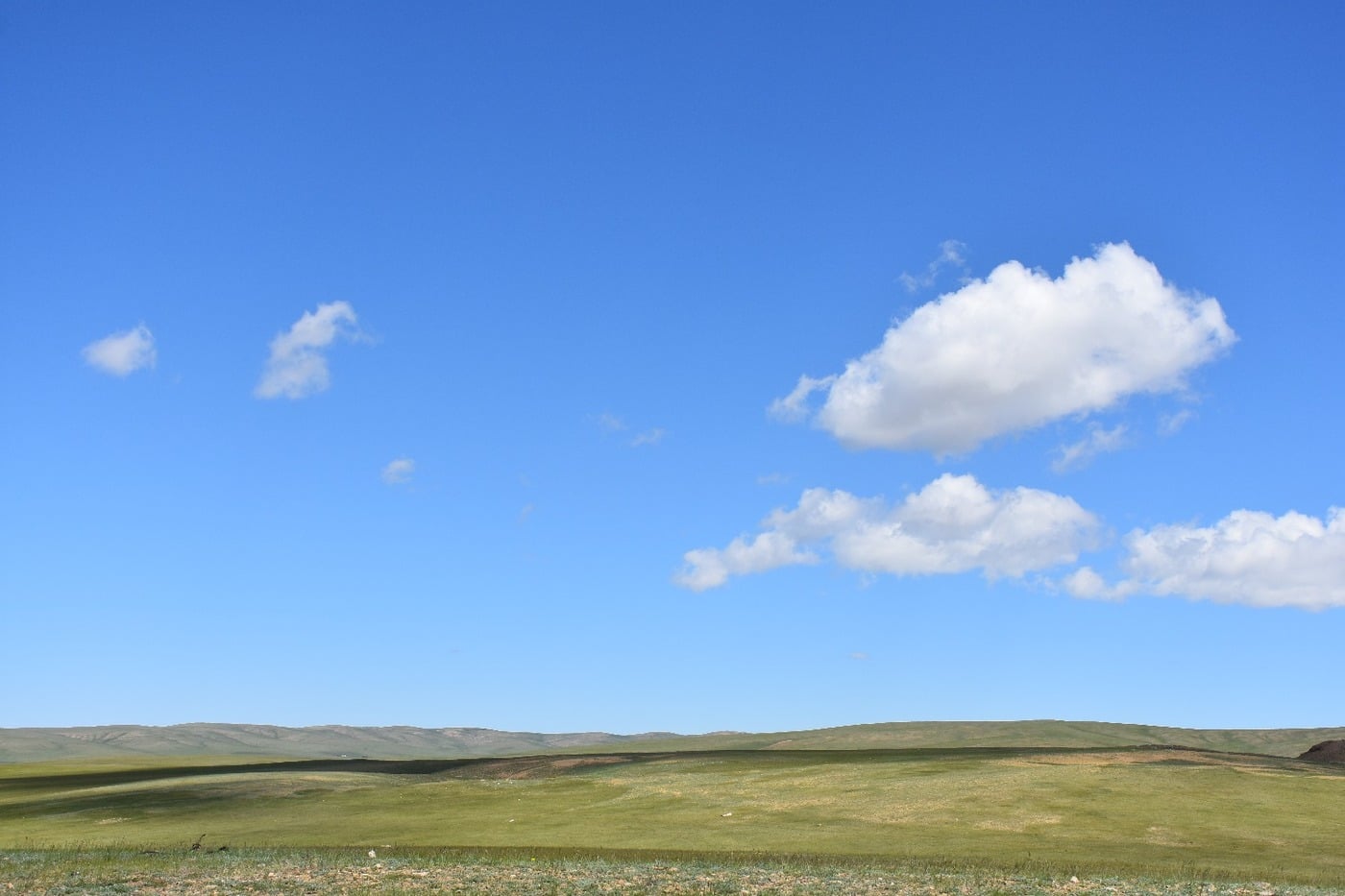
Rolling green steppe of the Mongolian countryside.
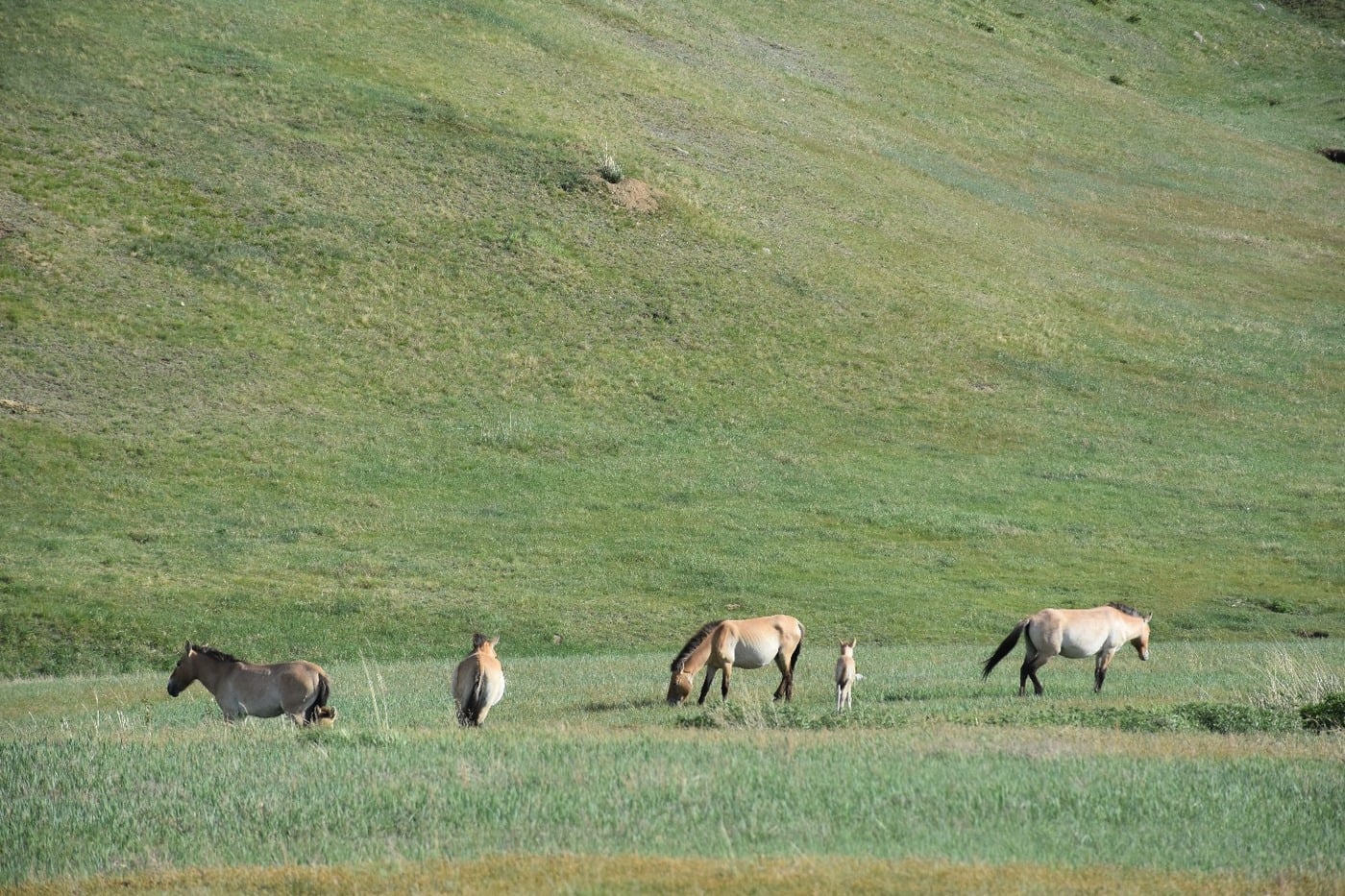
Takhi (Przewalski’s wild horses) roaming Hustai National Park.
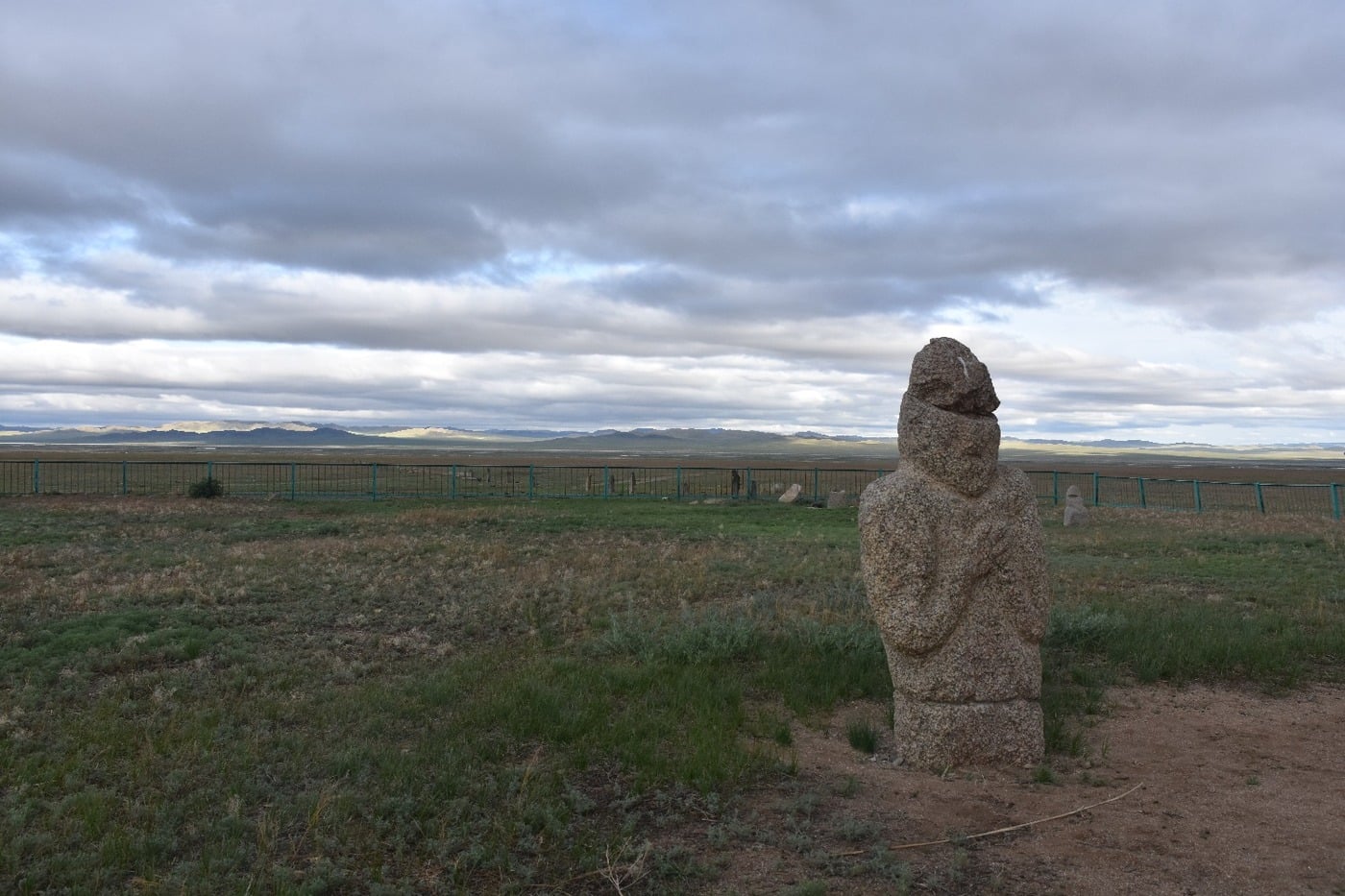
Ancient Turkic stone men monuments marking an ancient burial site.
Day 4 – 5
Karakorum: Ancient Imperial Capital & Tsenkher Thermal Springs
We journeyed westward toward Karakorum (Kharkhorin), where Chinggis (not “Genghis”!) Khan established the headquarters of the vast Mongol Empire in the 13th Century. En route, we paused at a monument honoring Jügderdemidiin Gürragchaa, Mongolia’s first and only cosmonaut.
At Erdene Zuu Monastery, established in 1586 as Mongolia’s earliest center of Tibetan Buddhism, we walked among white exterior walls crowned by 108 stupas. We sat down with a resident monk who shared deeply personal insights into how the complex survived the communist purges of the late 1930s, and the enduring resilience required to restore sacred monastic traditions. A short drive took us to the Imperial Map Monument, celebrating the three great empires that established their seats of power along the banks of the Orkhon River.
After touring the Karakorum Archaeological Museum the following morning, we headed toward the natural geothermal pools of Tsenkher Hot Springs. Each ger camp in this valley channels the thermal spring water directly into relaxing soaking pools. Walking up the hills toward the thermal source offered breathtaking scenery, mountain birdwatching, and our very first encounters with grazing yaks!
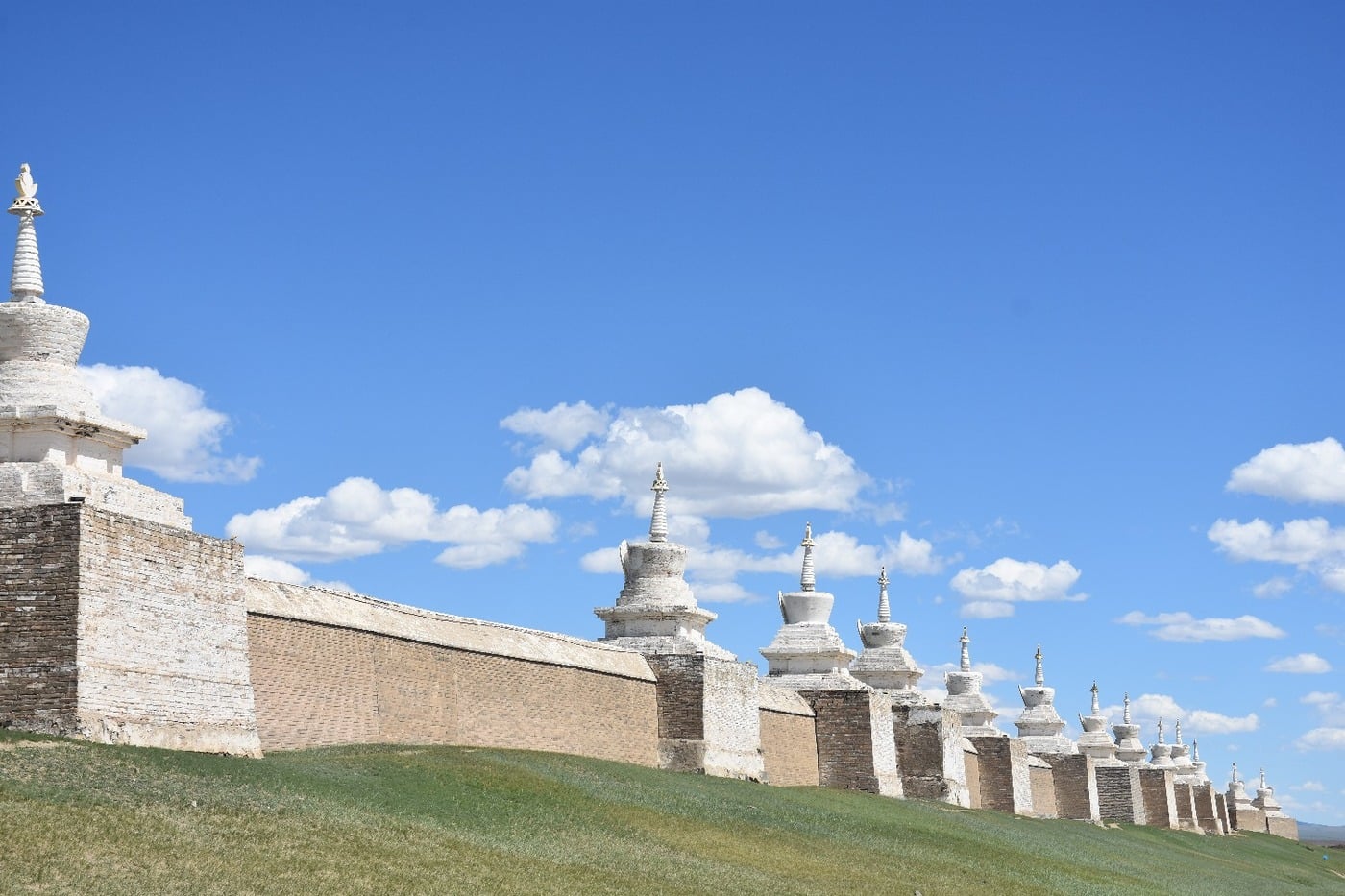
The perimeter wall of 108 stupas at Erdene Zuu Monastery.
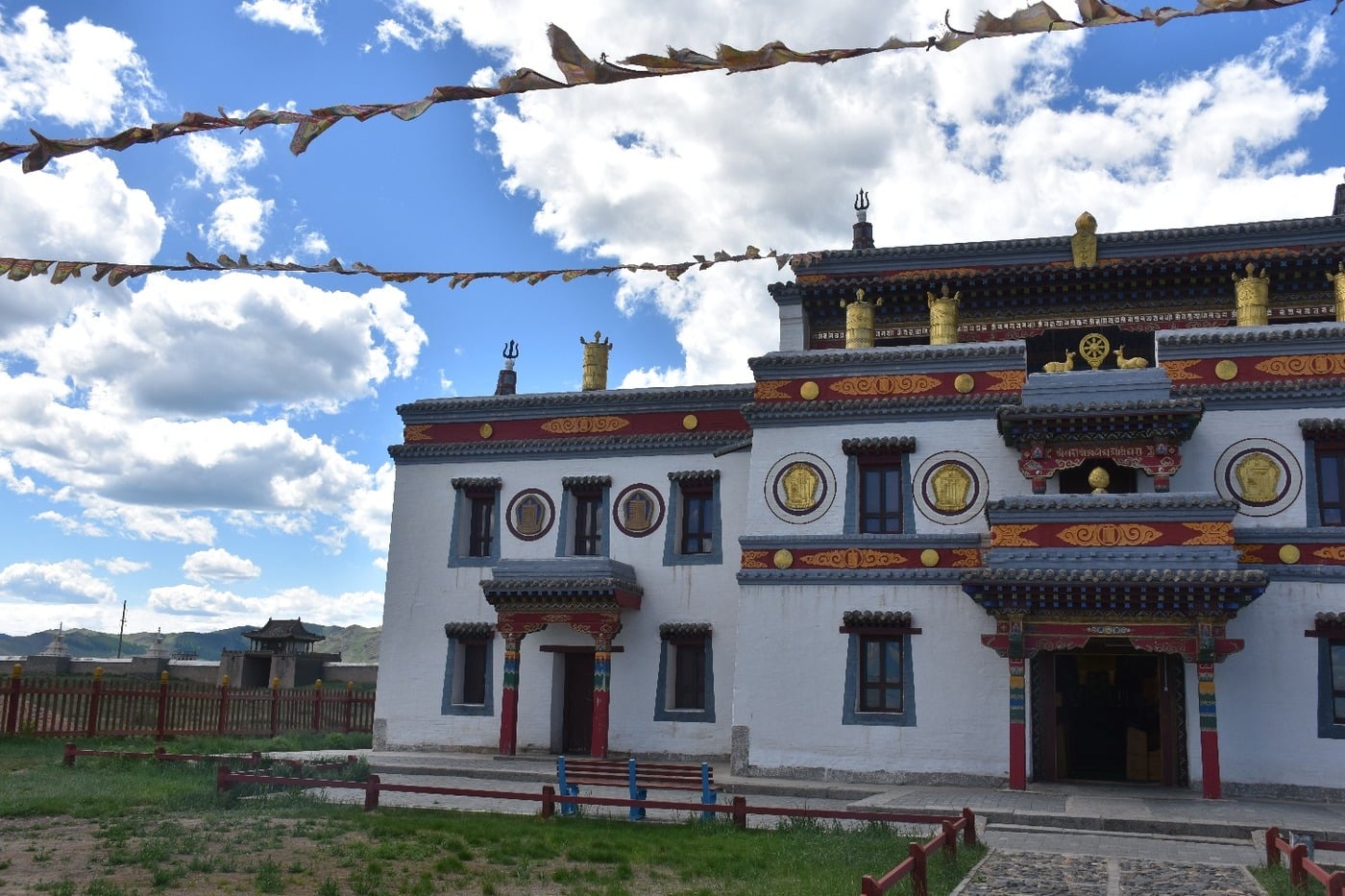
Historic temple sanctuary preserved within Erdene Zuu.
Imperial Map Monument overlooking the historical Orkhon River.
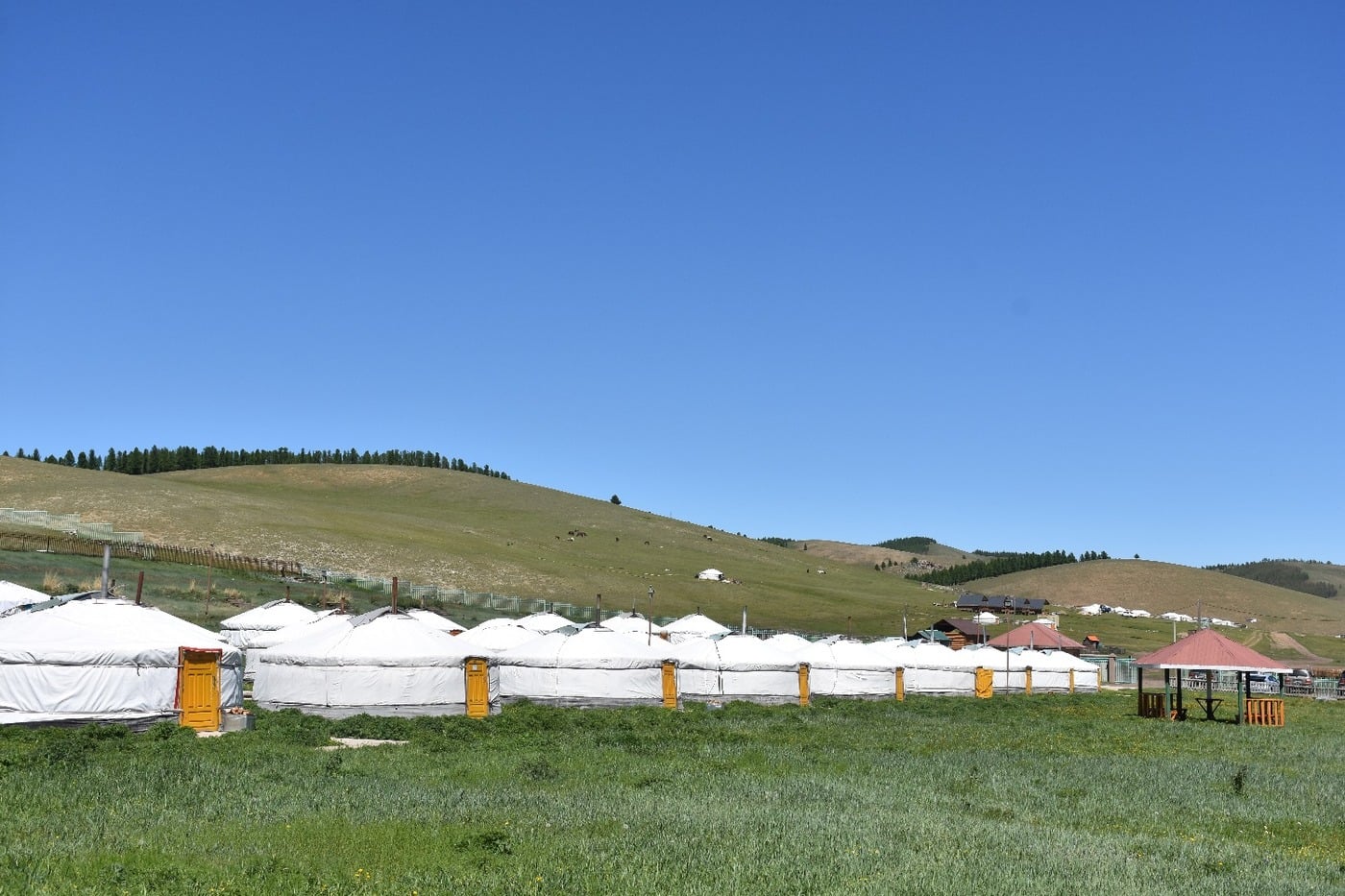
Tsenkher Hot Springs ger camp and outdoor mineral pools.
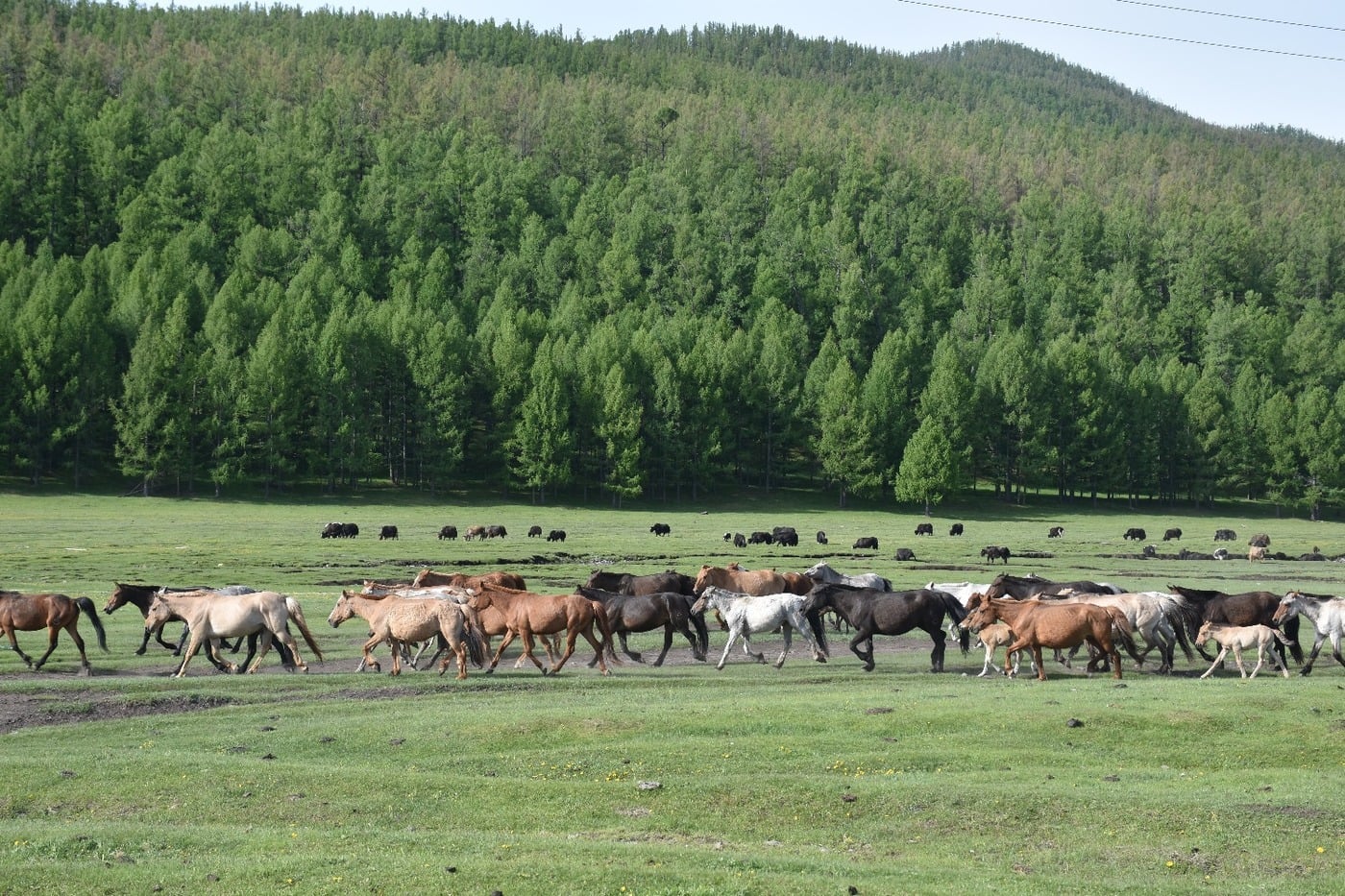
Steppe horses grazing the alpine meadows of Tsenkher.
Day 6 – 7
The Orkhon Valley: Waterfalls, Nomad Hospitality & Yak Vodka
Leaving the hot springs behind, our 4x4 convoy traversed the rolling green meadows of the Orkhon Valley, a designated UNESCO World Heritage Cultural Landscape recognized for two millennia of nomadic pastoral traditions. We paused for a scenic boxed picnic lunch overlooking the sweeping river valley.
From there, several members of our group hiked up the pine-forested mountain ridge to explore the ruins of Tuvkhun Monastery, founded in the 17th Century by Zanabazar, Mongolia’s first spiritual leader (Bogd Gegeen). Our CEO set clear expectations for the steep climb, allowing those of us who preferred a gentle afternoon to relax, breathe the fresh mountain air, and watch rain squalls drift serenely across the valley.
We spent two full nights at our next ger camp along the Red River (Ulaan Gol). A morning excursion brought us to the spectacular Orkhon Waterfall, which cascades 20 meters down over volcanic basalt cliffs into a churning river gorge.
In the afternoon, we experienced one of the most unforgettable moments of the entire journey: visiting the family ger of local nomadic herders. They welcomed us with open arms, demonstrating how they process fresh milk into traditional dried curds (aaruul) and spun sheep’s wool into yarn. They even offered us samples of shimiin arkhi—home-distilled yak milk vodka! Early the next morning, we returned to watch the family milk the yaks and care for newborn calves, followed by a hands-on dumpling-making (buuz) lesson back at camp.
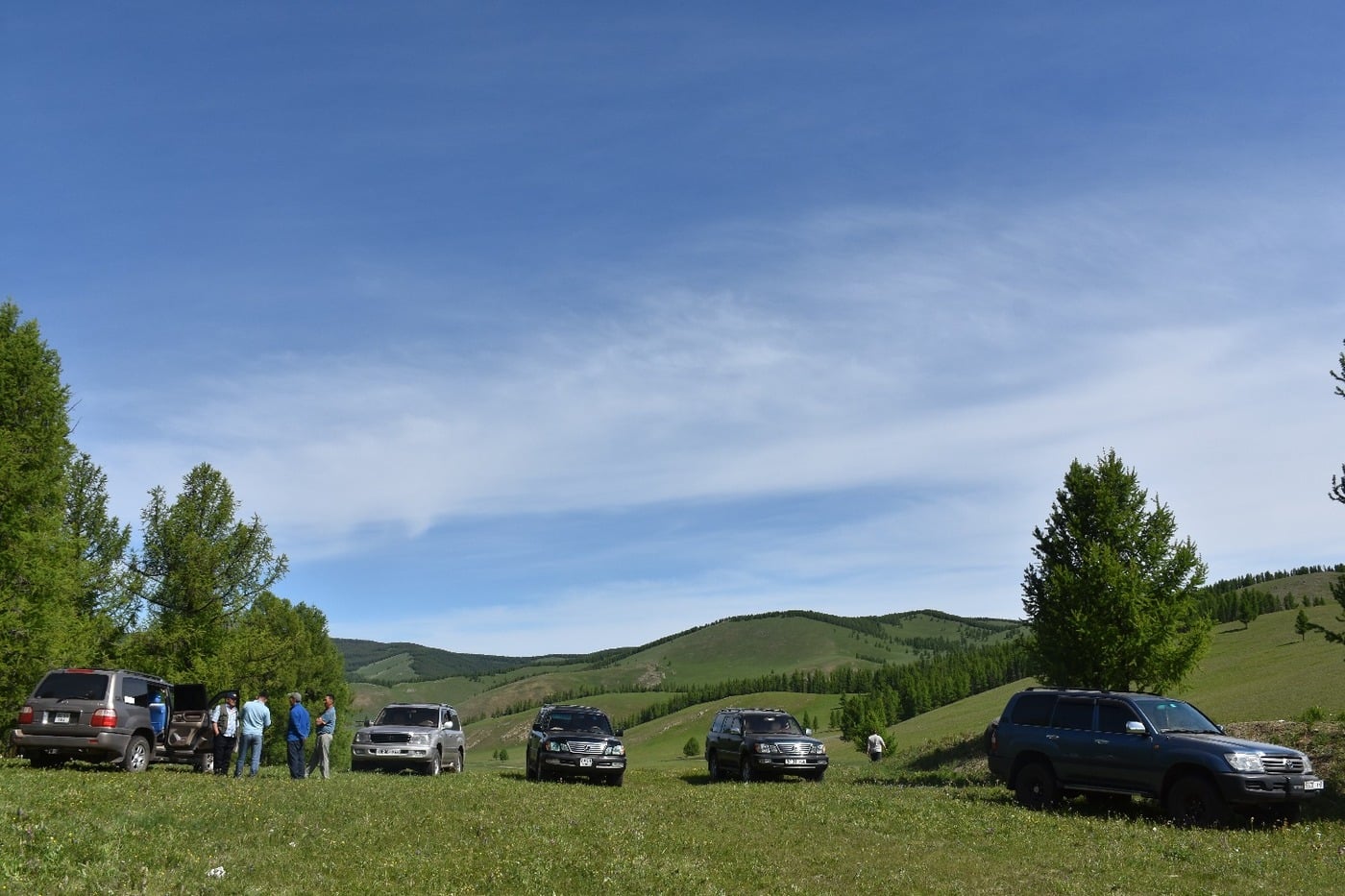
Our expedition convoy and skilled drivers during an overland lunch stop.
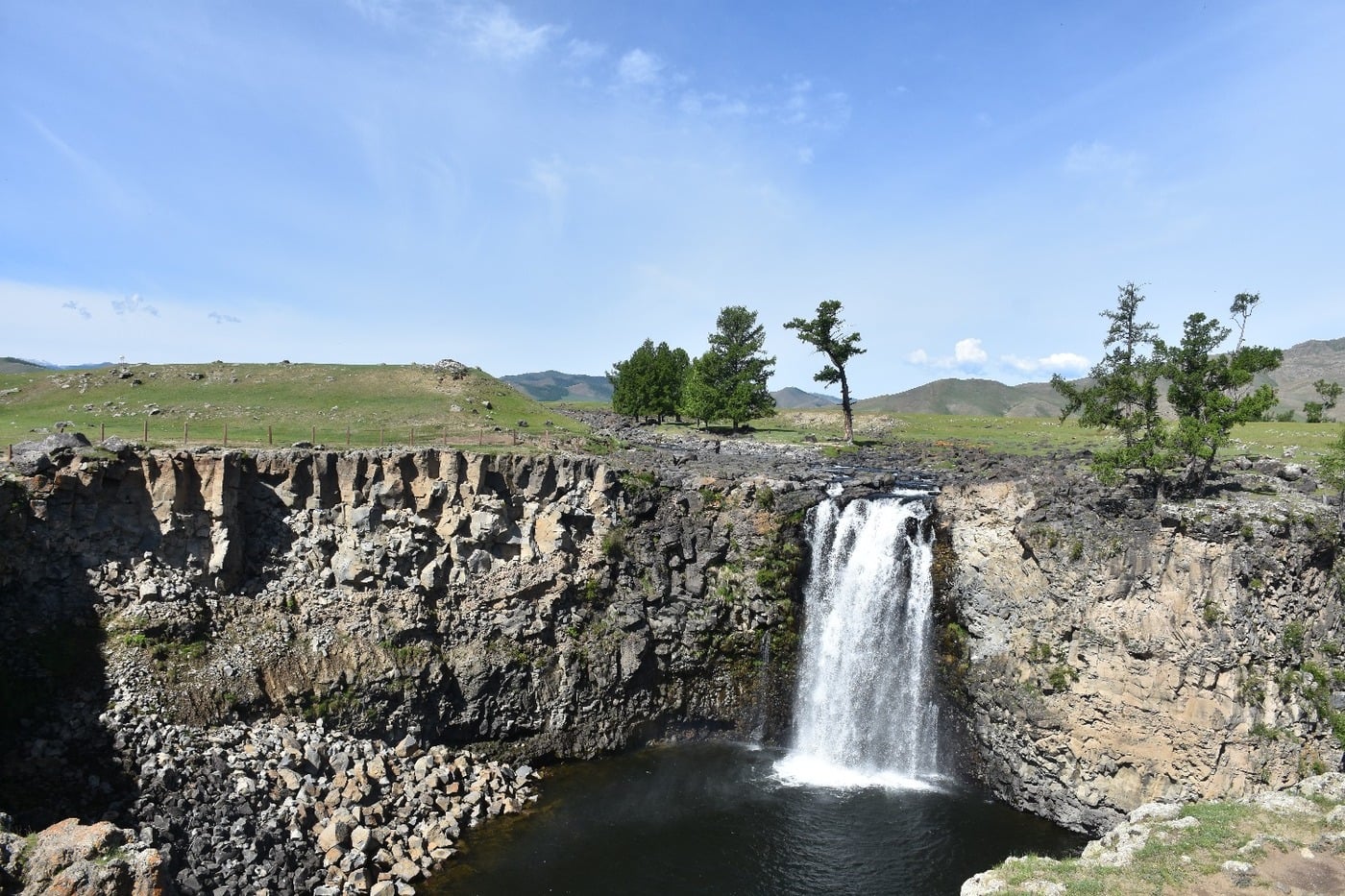
Orkhon Waterfall plunging 20 meters into the Red River canyon.
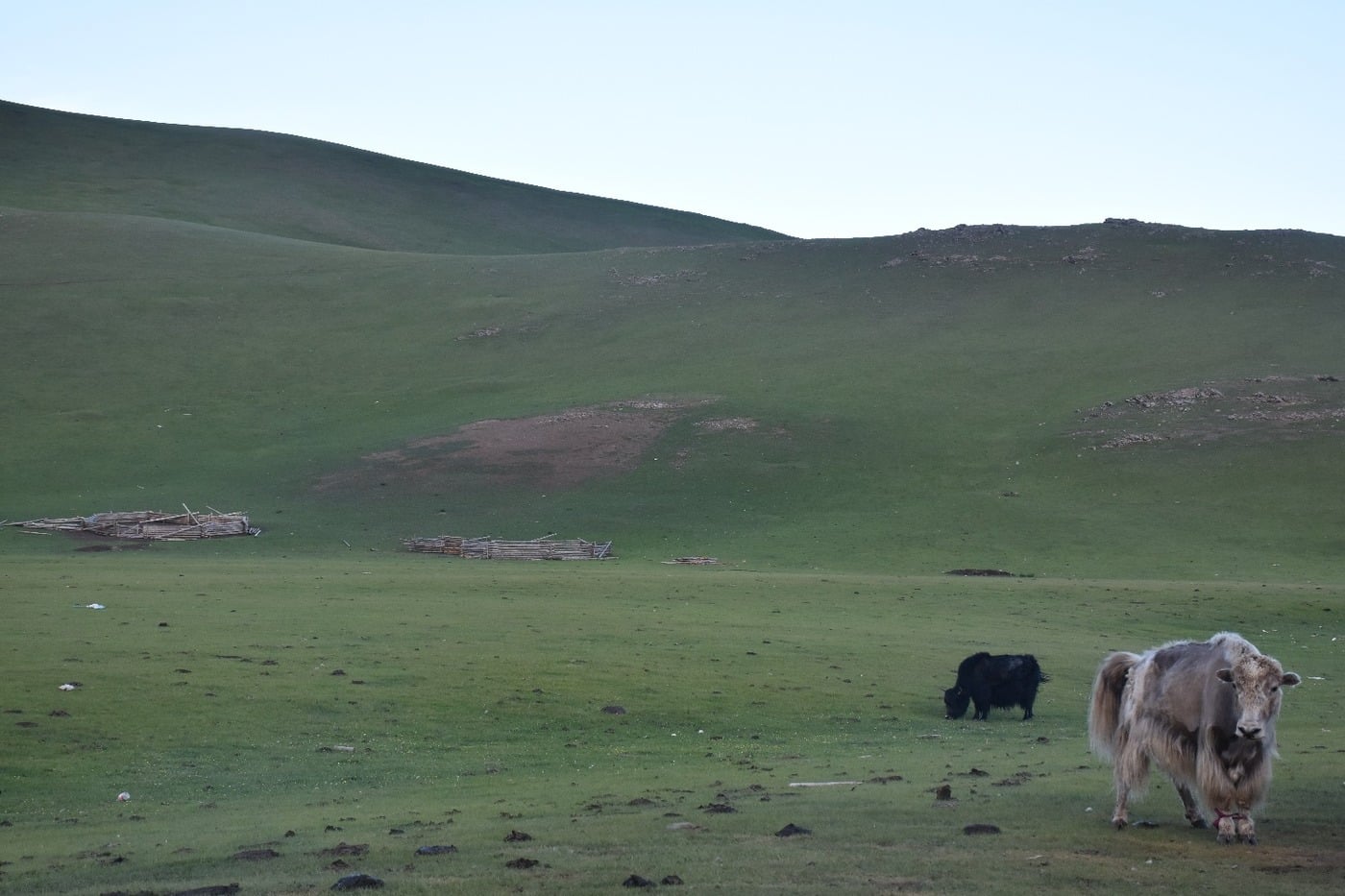
Domesticated yak grazing peacefully in the Orkhon Valley.
Day 8
Ongiin Khiid: Monastic Ruins in the Gateway to the Gobi
Transitioning southward from the lush steppe into the arid expanses of the Gobi Desert, the terrain flattened into dramatic desert plains. We stopped at a quiet river bend to honor monks who lost their lives during the religious purges of the Soviet era.
Arriving at Ongiin Khiid, we explored the remnants of two historic monastic complexes that once spanned both sides of the Ongi River. Founded in the late 17th Century, these monasteries once housed over 1,000 monks before their complete destruction in 1939. Walking among the stone foundations, we visited a small museum and active temple where dedicated monks are steadily rebuilding their sacred legacy.
Along the desert tracks, herds of two-humped Bactrian camels began to appear, wandering against the golden horizon—a quintessential symbol of ancient Silk Road trade.
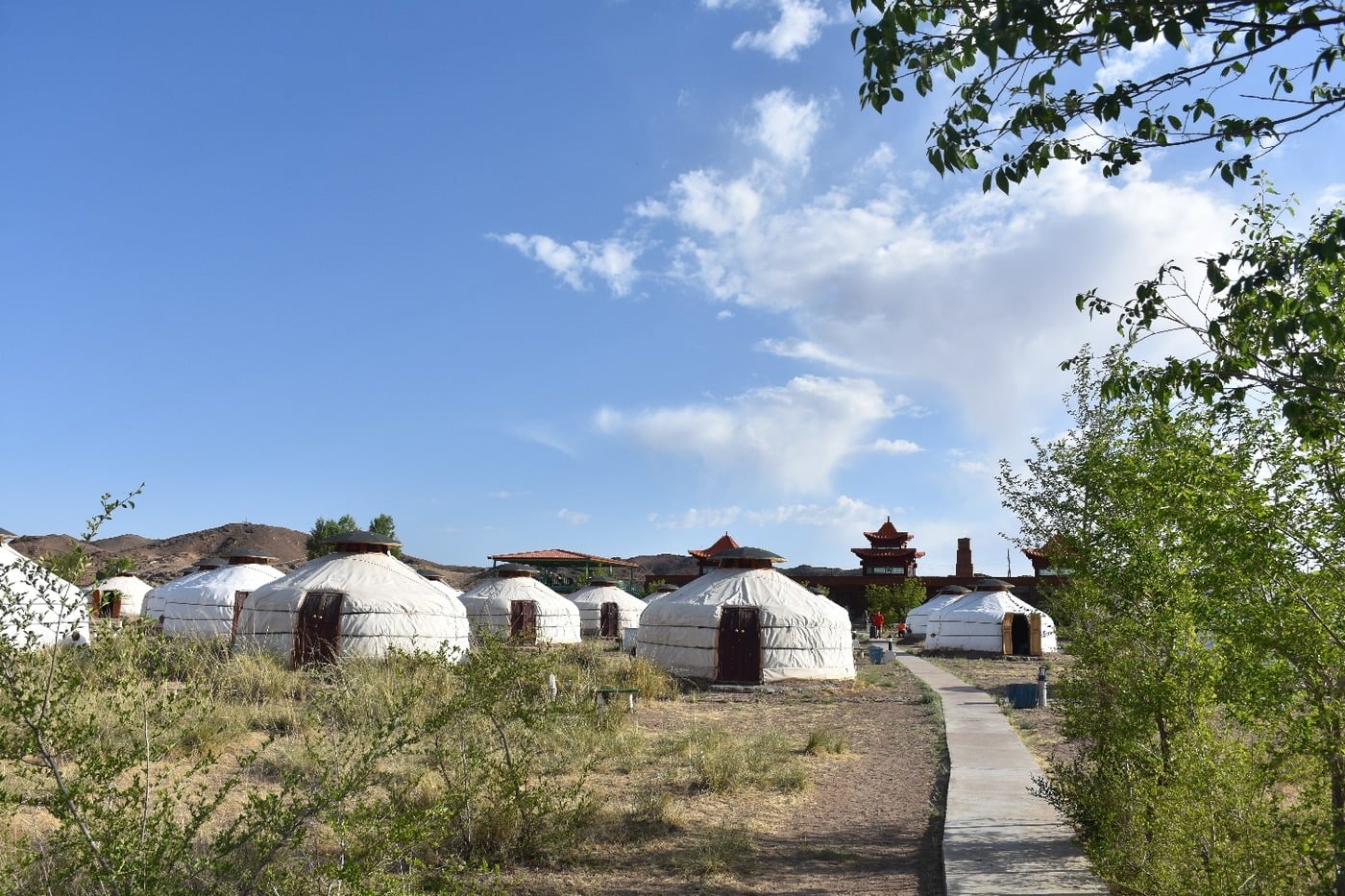
Our desert ger camp nestled near Ongiin Khiid in the Gobi.
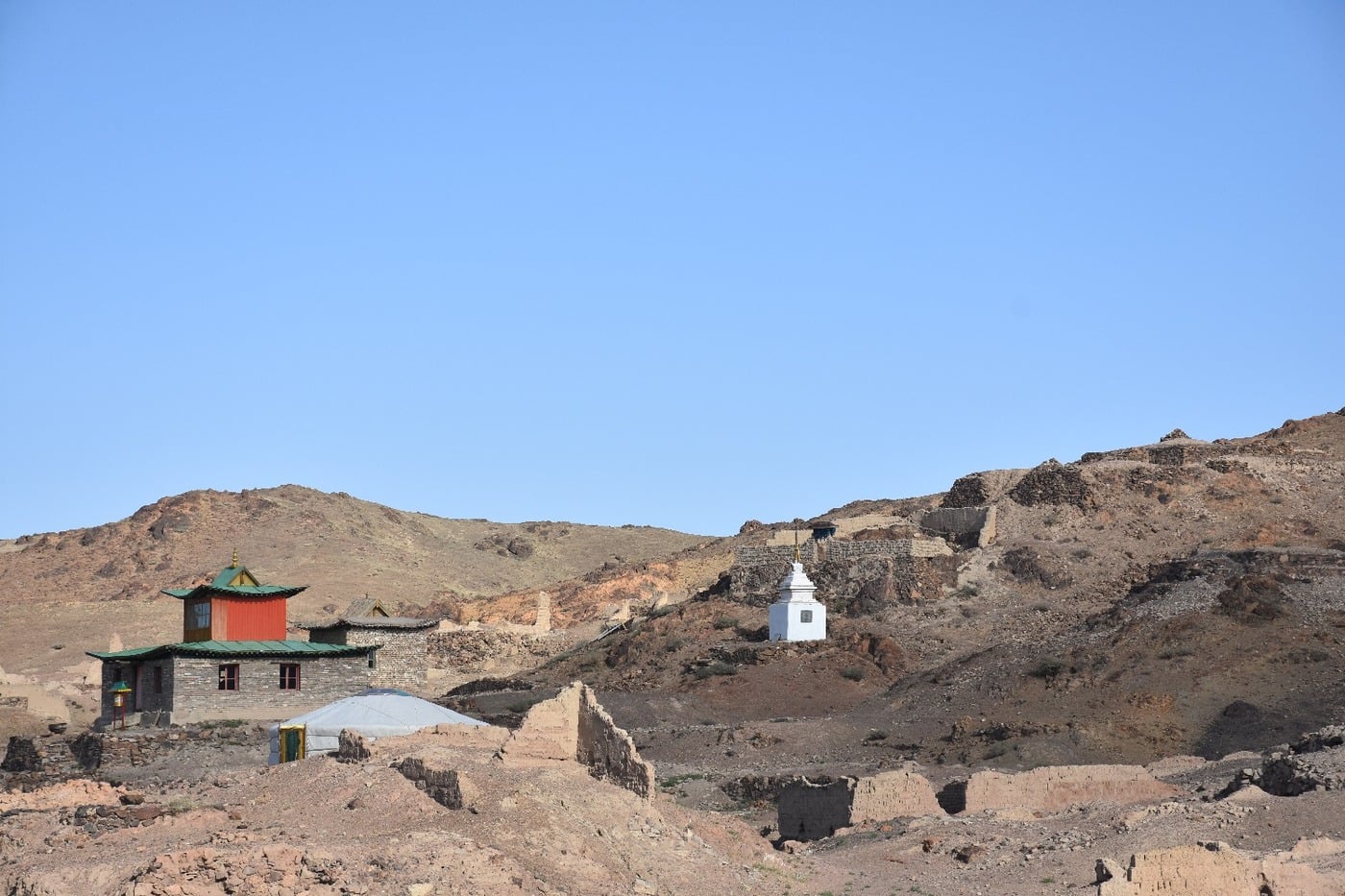
17th-century monastic ruins undergoing restoration at Ongiin Khiid.
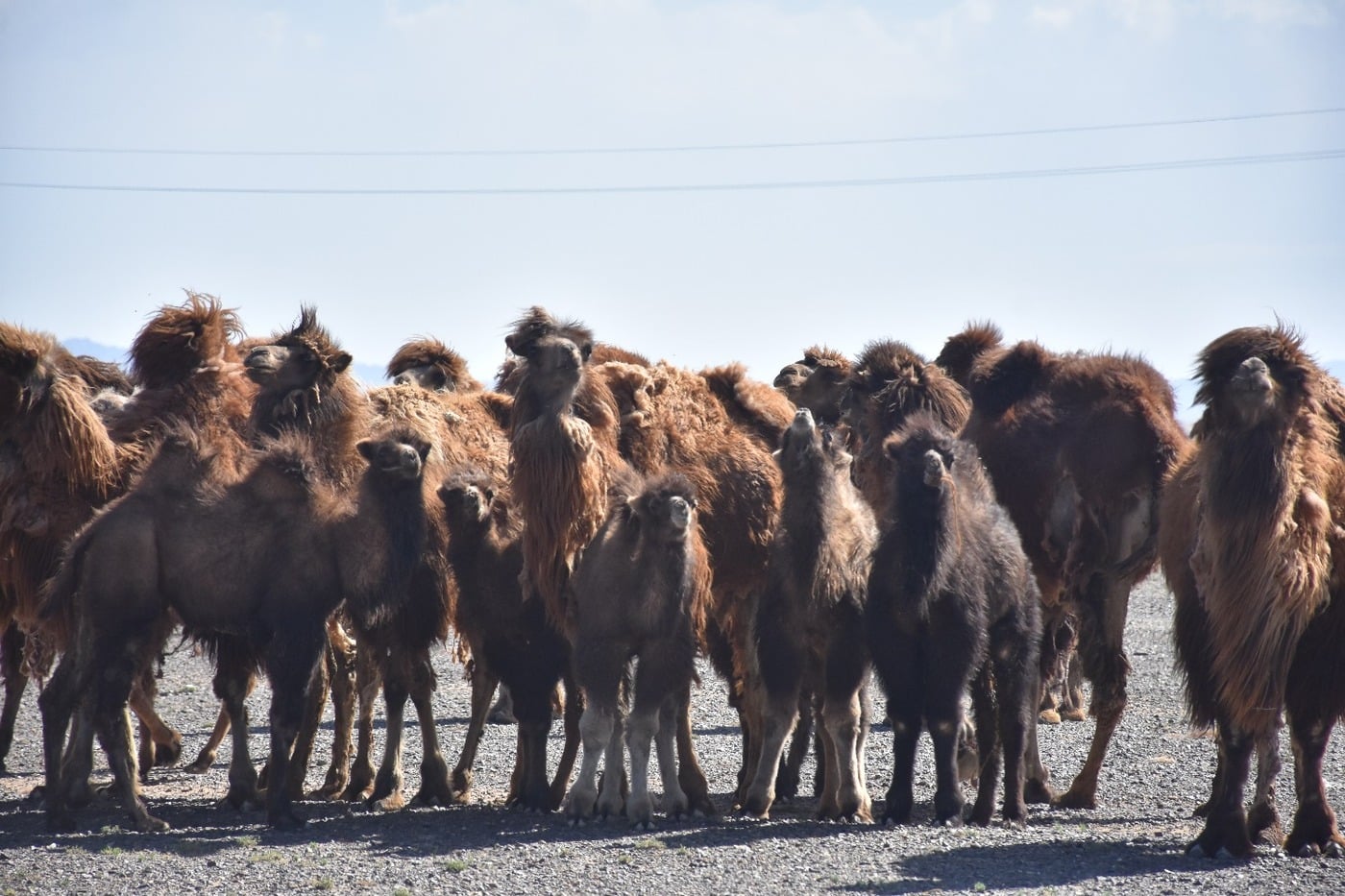
Two-humped Bactrian camels roaming the open desert plains.
Day 9
The Flaming Cliffs of Bayanzag: Cradle of Dinosaur Discoveries
Day nine brought us to one of the world’s most revered paleontological landmarks: the Flaming Cliffs (Bayanzag). On our way, we paused at another restored Buddhist monastery where the head monk is believed to be the direct reincarnation of the temple’s original founder.
A visitor museum at the entrance presents documentary footage celebrating the legendary 1920s expeditions led by American explorer Roy Chapman Andrews of the American Museum of Natural History. It was right here that Andrews and his team made the historic discovery of the first fossilized dinosaur eggs ever known to science, alongside skeletons of Protoceratops and Velociraptor.
After photographing the nearby Silk Road monument and exploring the rust-orange gullies, we checked into camp for dinner before returning to the cliffs precisely at sunset. As the late afternoon rays struck the red clay and sandstone escarpments, the bluffs literally appeared to be ablaze in roaring fire—an otherworldly spectacle etched into memory forever.
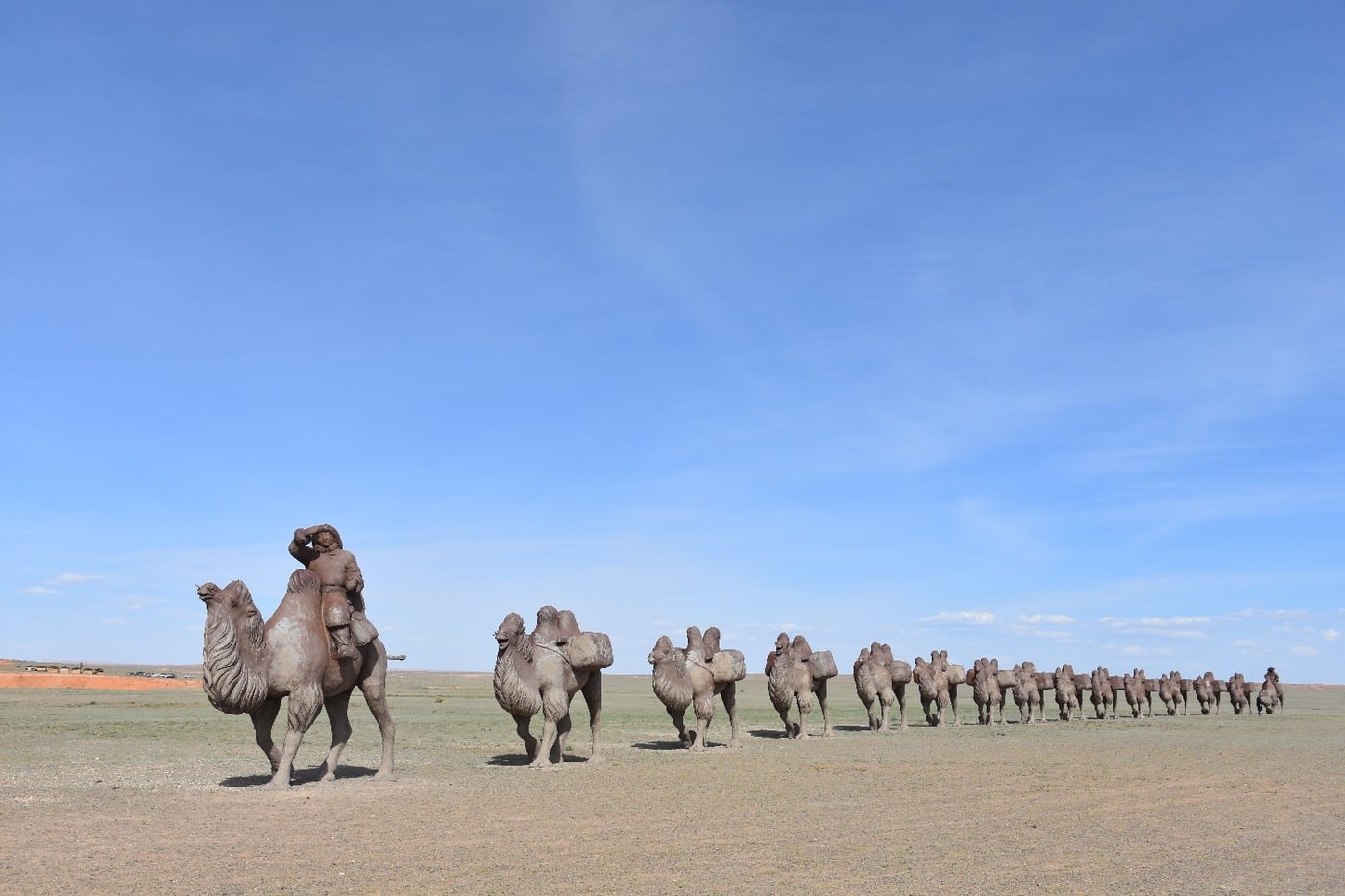
Silk Road commemorative monument standing tall in the Gobi.
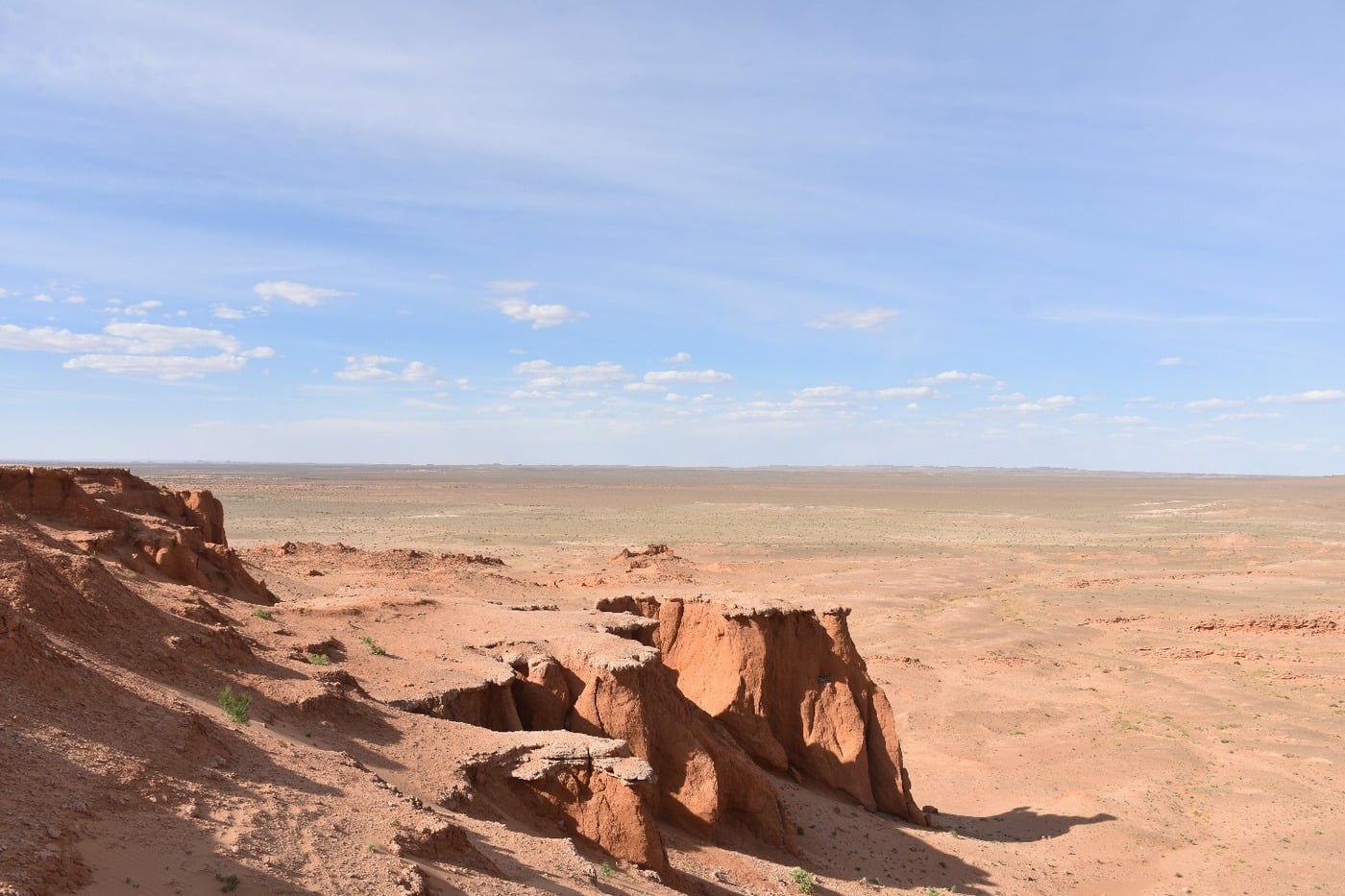
The dramatic red sandstone formations of Bayanzag.
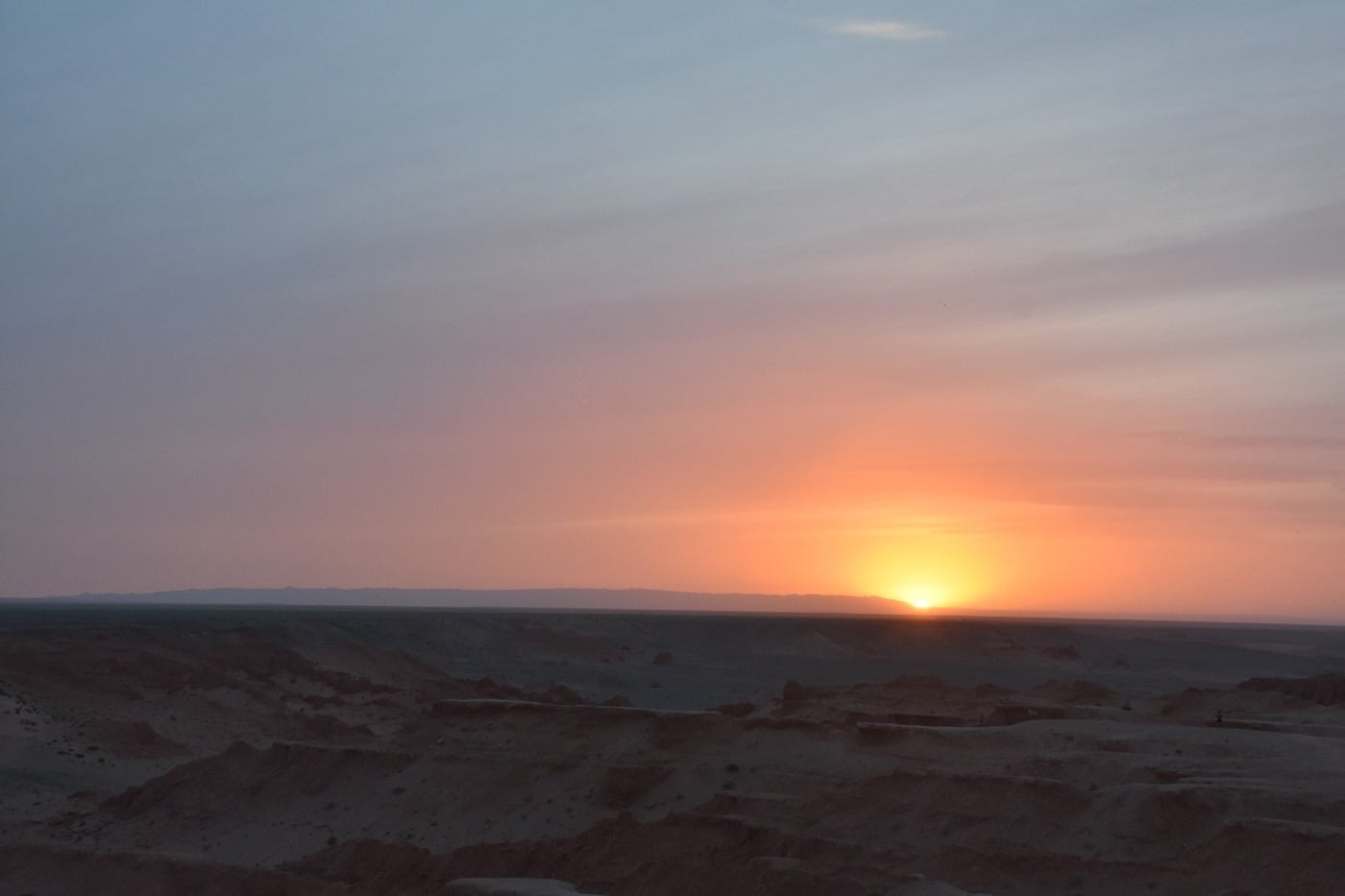
Sunset setting the Flaming Cliffs ablaze in fiery crimson hues.
Day 10 – 11
Singing Sands of Khongoryn Els & Yolyn Am Ice Canyon
Next on our desert journey were the breathtaking dunes of Khongoryn Els, known as the “Singing Sands.” Reaching heights of up to 300 meters and stretching for over 100 kilometers, these massive dunes produce a low, melodic drone when the desert wind shifts the crests. A few adventurous travelers in our group hiked to the razor-sharp ridgeline and attempted sand-sledding down.
At the base of the massive dunes lies a startling natural spring that creates a lush green ribbon of grass and wetlands. Seeing a herd of semi-wild horses grazing against the backdrop of towering sand dunes was pure magic. Our guide led us right to where the spring emerges from the earth—the water was crystal clear, ice-cold, and remarkably sweet.
The following morning, we drove into the Gurvan Saikhan Mountains to explore Yolyn Am (the Valley of the Eagles). This deep, narrow canyon is shielded from direct sunlight, allowing a thick gorge of winter ice to linger deep into the summer months. Walking across slush in the middle of the Gobi Desert is an unforgettable, surreal sensation! As we trekked along the rocky gorge floor, we spotted tiny pikas scurrying among boulders and observed a majestic pair of Bearded Vultures (Lammergeier) soaring effortlessly overhead.
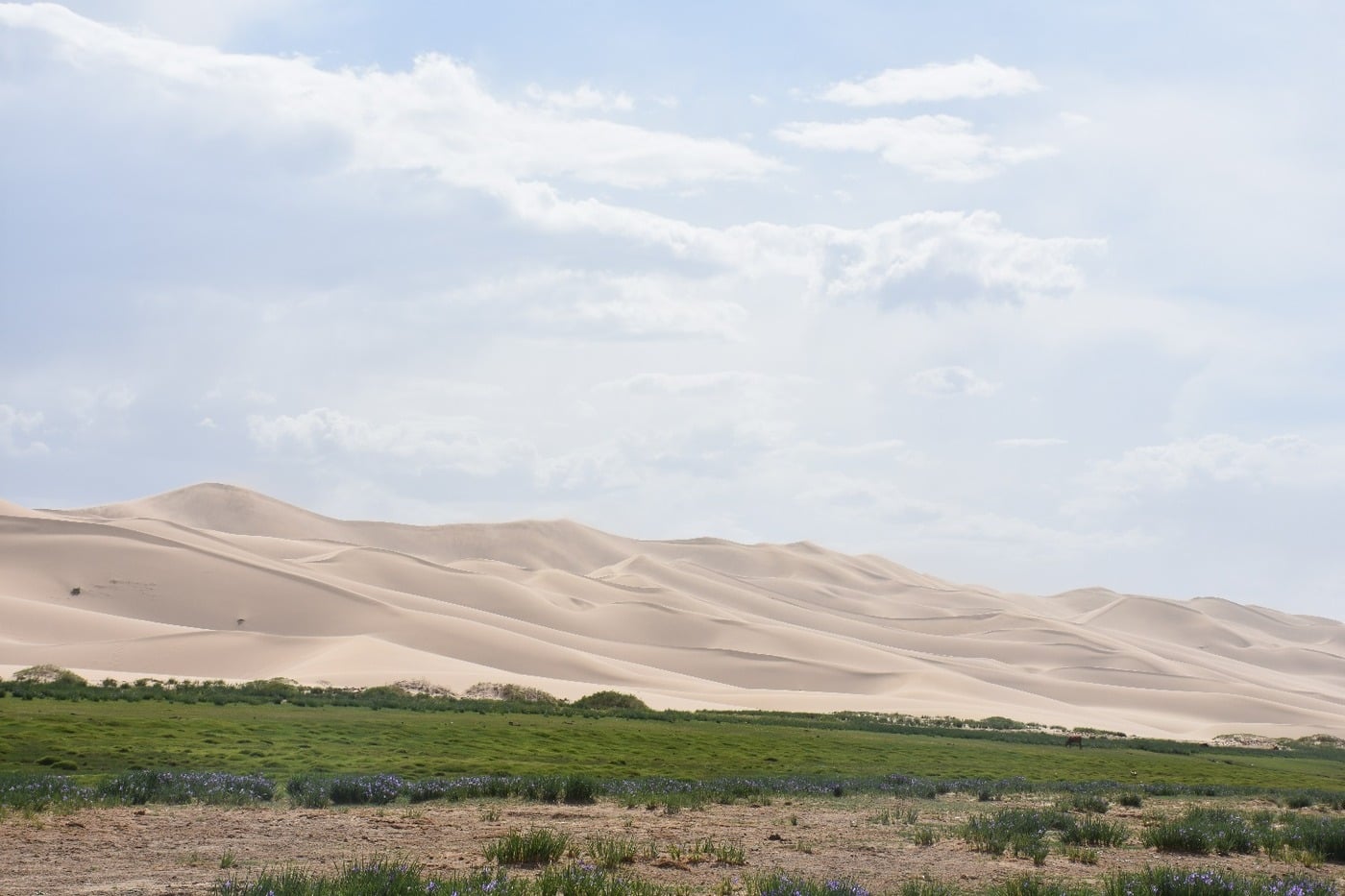
The towering dunes of Khongoryn Els (The Singing Sands).
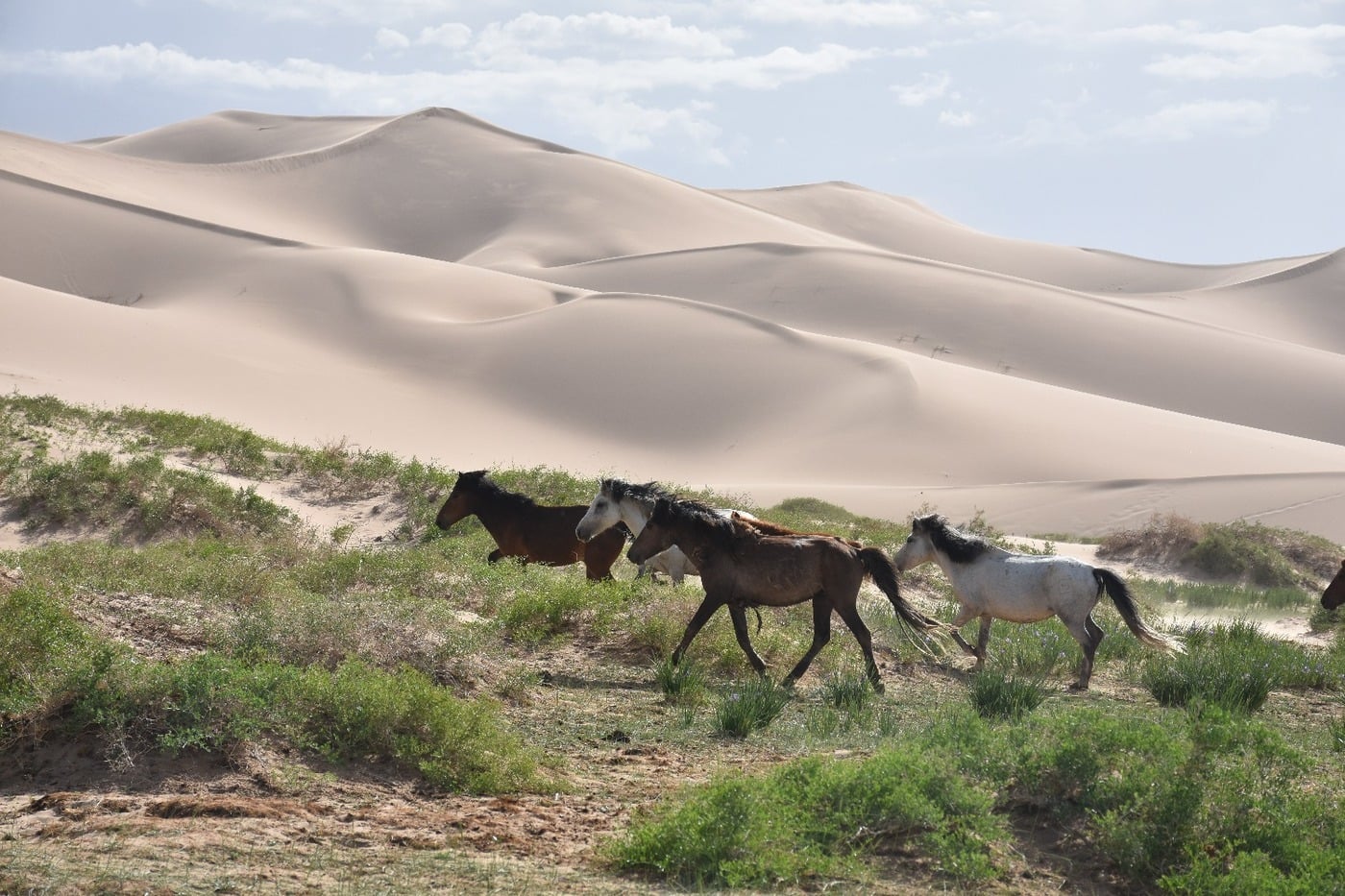
Horses grazing by the freshwater oasis spring at the dune base.
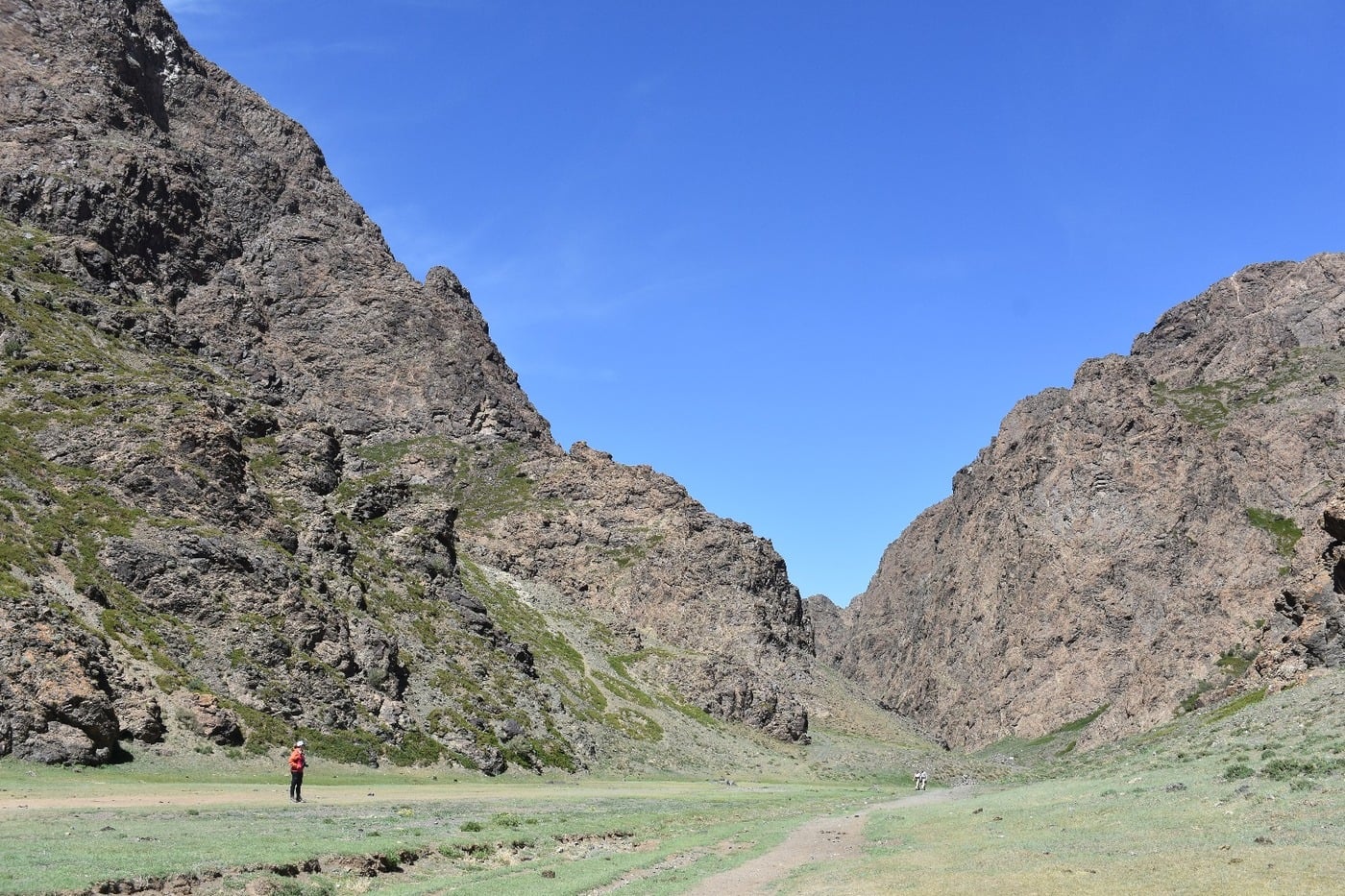
Walking through the dramatic rock gorge and summer ice of Yolyn Am.
Day 12 – 14
Middle Gobi Archaeology, Throat Singing & Homeward Bound
Our final full day in the desert took us northward through the Middle Gobi. As we crossed into each new province (aimag), we passed through decorative monumental entry arches marking provincial borders. At one checkpoint, a national television news crew was filming a feature and even conducted an impromptu interview with one of our traveling companions!
In the afternoon, we arrived at Baga Gazriin Chuluu, a surreal maze of weathered granite rock formations rising out of the basalt steppe. This area has sheltered humans since the Bronze Age. Tucked among the rocks, we visited the ruins of a 17th-century monastery and conversed with a resident monk. By incredible luck, we encountered an active field excavation team from the University of Mongolia’s School of Archaeology, learning firsthand about the Bronze Age petroglyphs and burial artifacts they were unearthing.
Upon returning to Ulaanbaatar the next afternoon, a hot shower was blissfully welcomed after days on the dusty road! That evening, we attended the world-renowned Tumen Ekh Ensemble performance at the Children’s Palace. This riveting one-hour cultural performance showcases traditional Mongolian throat singing (khoomei), the haunting melodies of the horse-head fiddle (morin khuur), classical palace dances, and incredible contortionists.
Our departure day was seamless: our G Adventures CEO arranged our airport transfer to the new Chinggis Khaan International Airport (which opened in 2021, located about an hour outside the capital). Modern, spotless, and easy to navigate, the airport offered duty-free shops where I purchased authentic Mongolian cashmere shawls and handmade boiled wool slippers. My return flights with Korean Air (Ulaanbaatar – Seoul – Los Angeles) were flawless, featuring exceptional food and warm service.
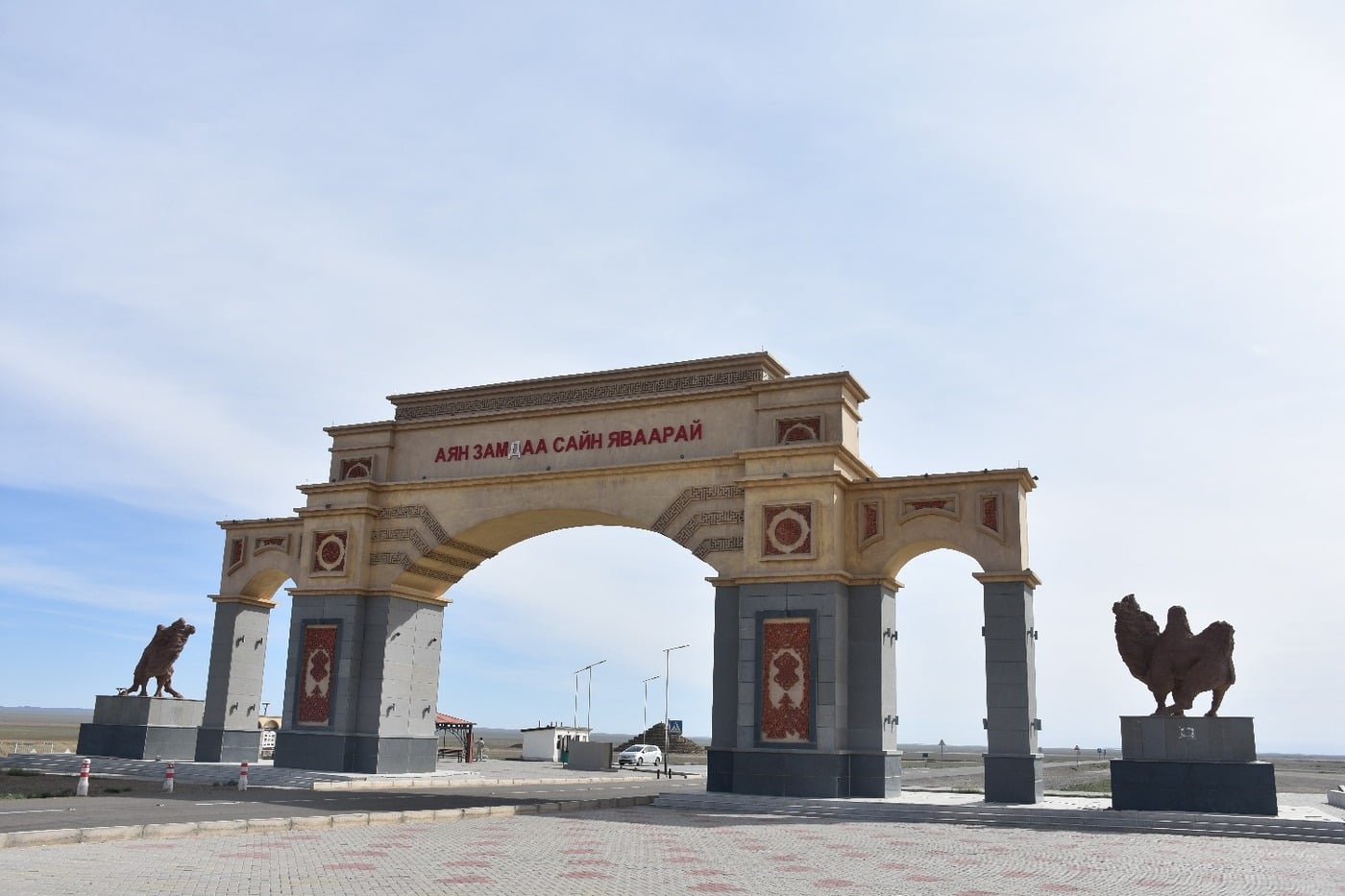
Decorative gateway arch entering a new Mongolian province.
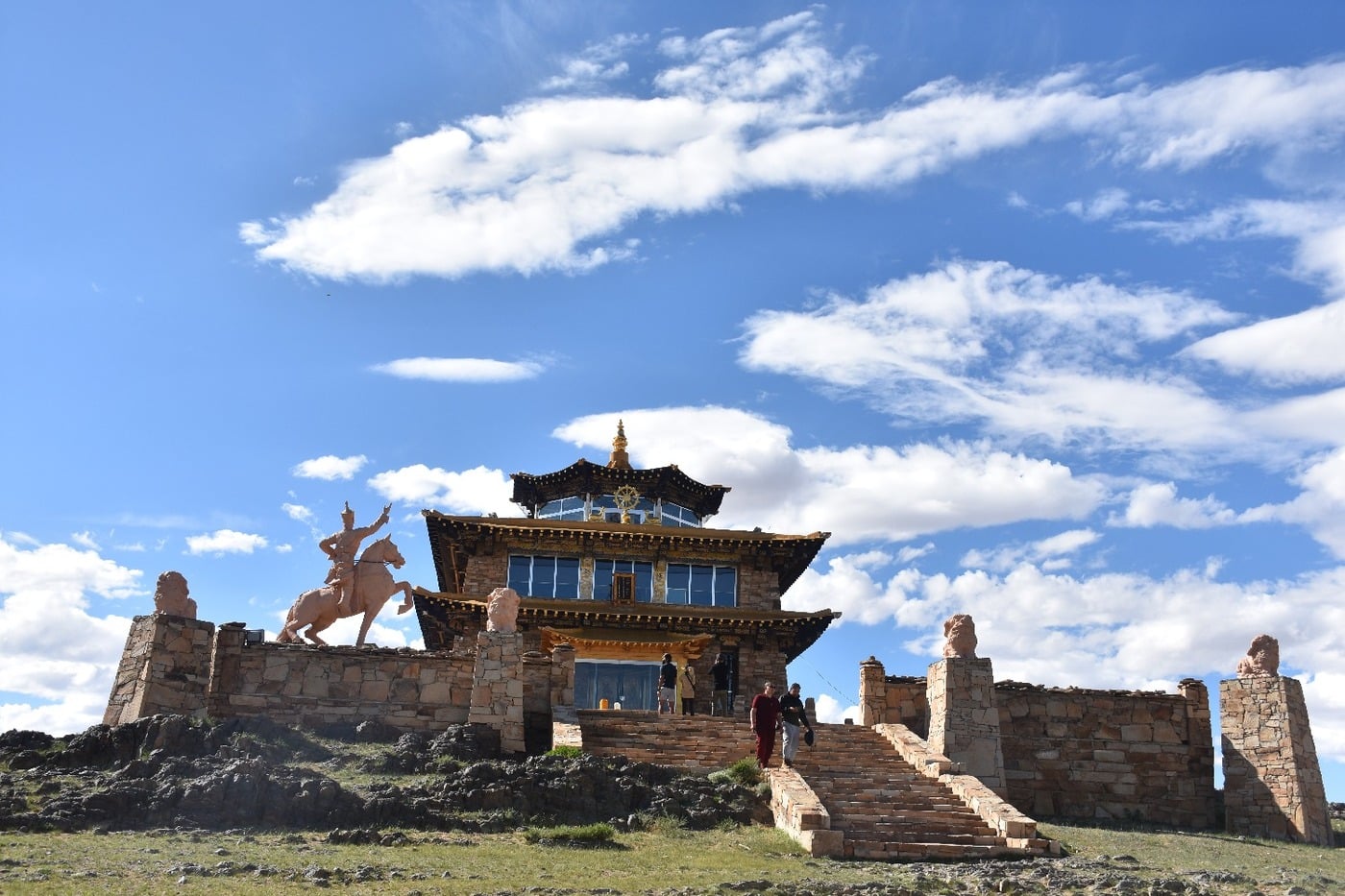
17th-century temple hidden within Baga Gazriin Chuluu.
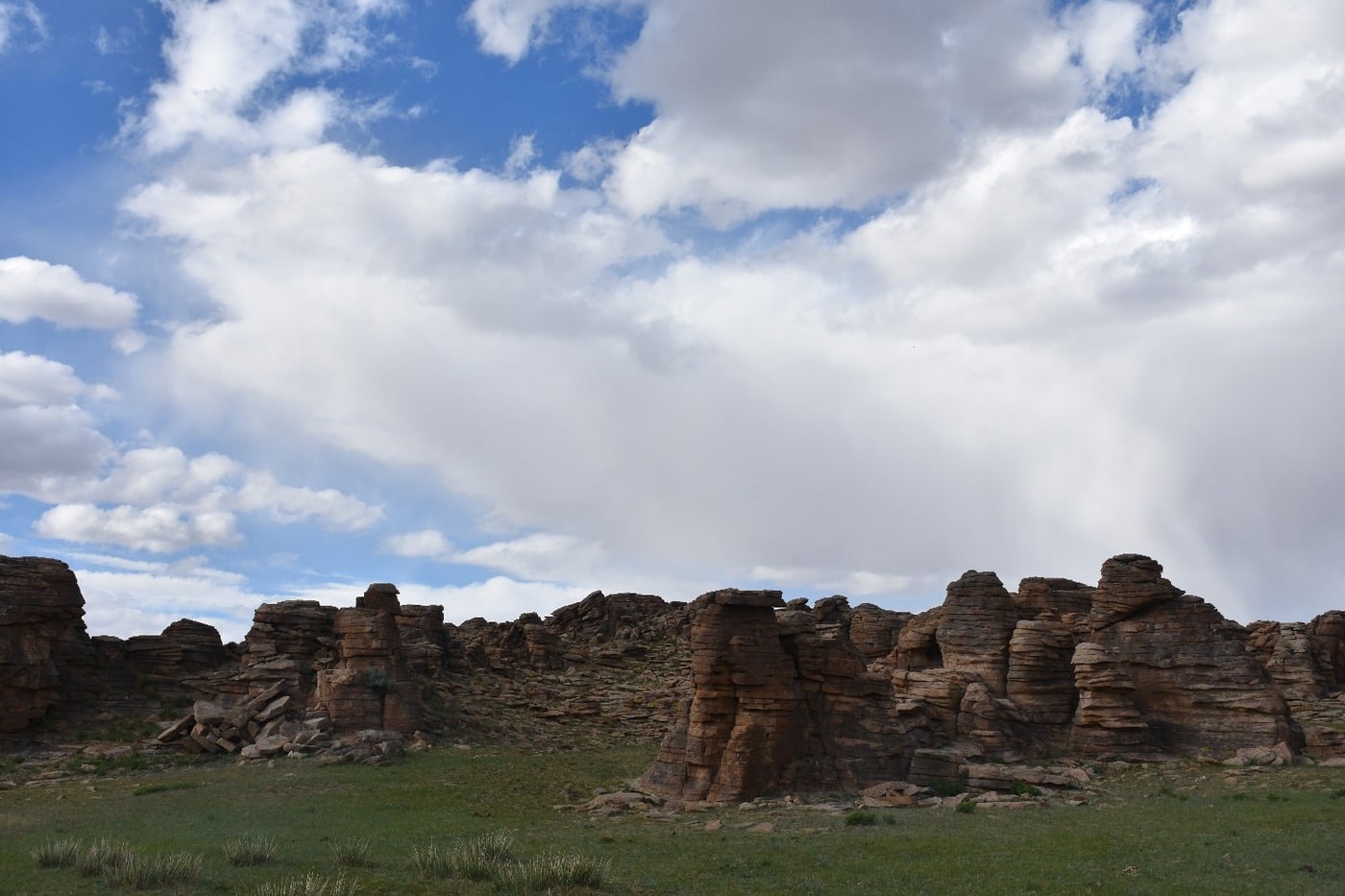
Granite rock formations and Bronze Age archaeological site.
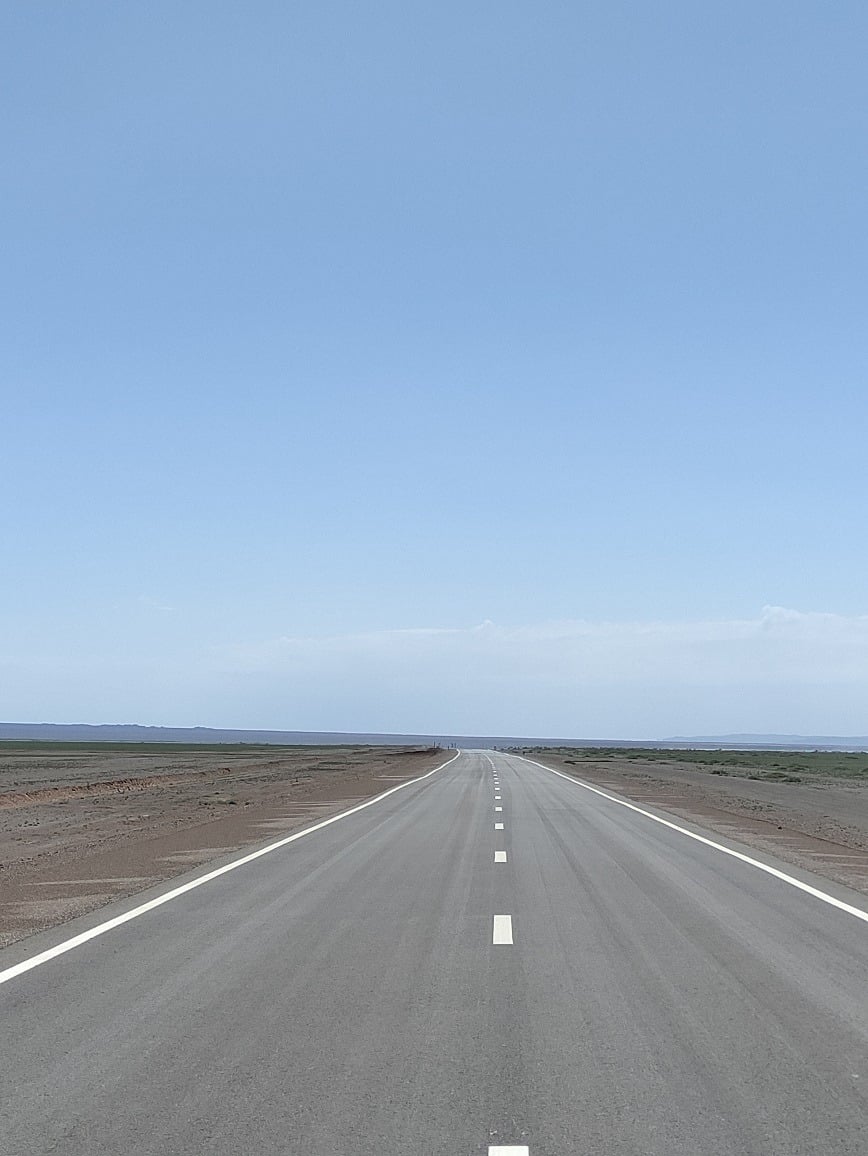
Paved highway sections connecting major regional hubs.
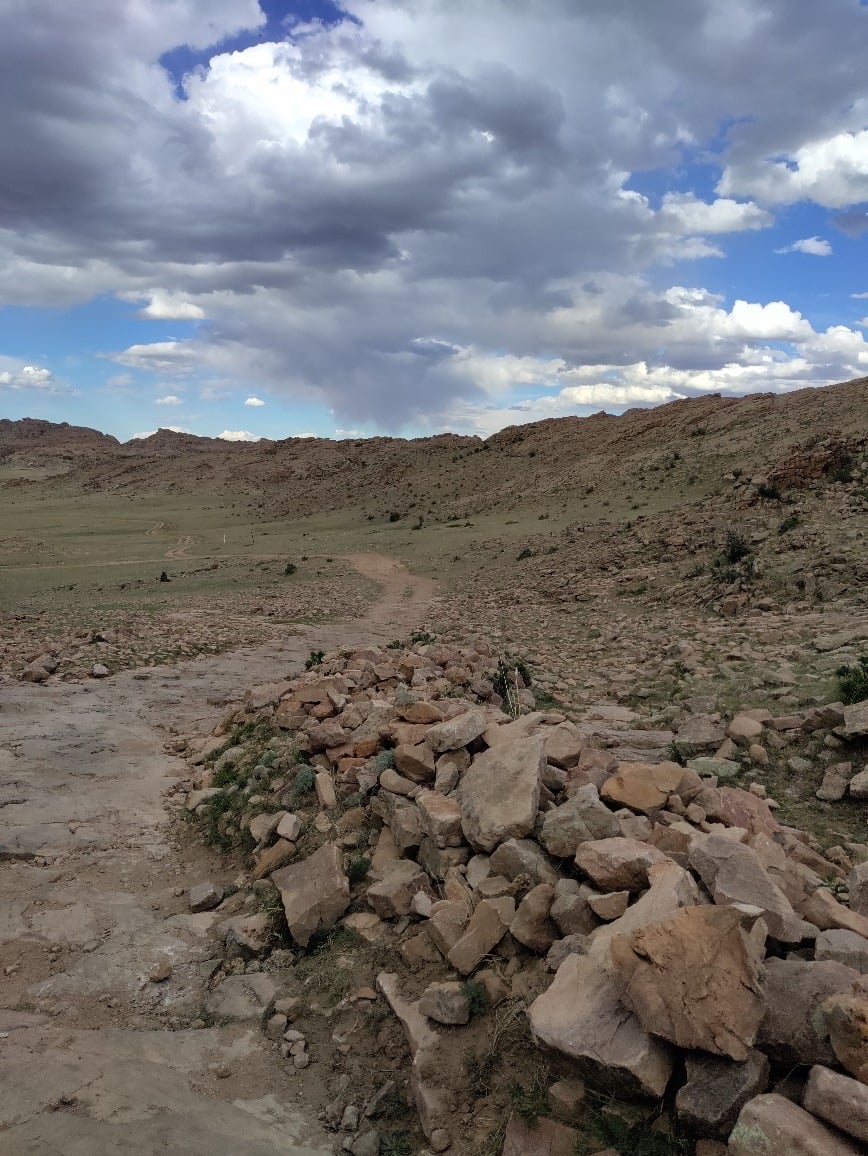
Unpaved desert tracks requiring sturdy 4x4 vehicles.
Luxury Advisor Guide: Planning Your Mongolia Overland Expedition
Mongolia is an intensely rewarding, life-changing destination, but it requires realistic expectations and proper preparation. As your Vincent Vacations expedition specialists, here are the essential insights every traveler needs to know:
Roads & Overland Travel
Outside Ulaanbaatar, most roads are unpaved dirt tracks through the desert. G Adventures uses reliable 4x4 vehicles with only 3 travelers per car, guaranteeing a window seat for all.
Ger Camp Comforts
Ger camps provide real beds, tables, and wood-burning stoves for cool nights. Camps feature communal flush toilets and hot showers (water pressure can vary with desert conditions).
Currency & Payments
Mongolian Tugrik (MNT) is required for markets and camp extras. Exchange $200–$250 USD at Ulaanbaatar banks or airport upon arrival. Credit cards are accepted only in the capital.
Packing & Layers
Expect temperature swings from 39°F at night to 70°F+ midday. Pack thermal base layers, a lightweight down jacket, sturdy hiking shoes, sun protection, and personal wet wipes.
“Mongolia is a very beautiful country and its people are quite lovely and kind. If you, or your clients, are able to go with the flow and roll with less than luxury accommodations, Mongolia will be the trip of a lifetime. Personally, I’d go back again in a heartbeat.” — Karen Lee Elder
Ready to Discover the Wild Wonder of Mongolia?
From witnessing wild Takhi horses and ancient Buddhist monasteries to experiencing nomad ger hospitality and watching the Flaming Cliffs ignite at sunset, Vincent Vacations secures your preferred G Adventures departures with exclusive Signature Travel Network perks and full expert support.
Plan Your Mongolia Expedition →
Prefer to speak directly with Karen Lee Elder or an Adventure Specialist? Call (888) 803-4177
Frequently Asked Questions: Discover Mongolia with G Adventures
What makes G Adventures’ National Geographic Journeys tours different?
▼
National Geographic Journeys tours feature an Upgraded Service Level, including upgraded accommodations, more included meals, private 4x4 convoy transportation, all entrance fees, and exclusive insider cultural access. Furthermore, they maintain intimate small-group sizes (averaging 12, max 14) and high Ripple Scores (100% on the Discover Mongolia tour), ensuring maximum economic benefit remains in local communities.
What are accommodations like on an overland tour through Mongolia?
▼
In Ulaanbaatar, guests stay in modern, upscale international hotels. In the countryside, accommodations are traditional ger camps. Each ger is furnished with comfortable single or double beds, warm linens, and a central wood-burning cast-iron stove lit in the evenings. Camps feature dedicated dining facilities and shared bathhouses with hot showers and flush toilets.
When is the best time of year to visit Mongolia?
▼
The optimal window for overland travel in Mongolia is from late May through September. June, July, and August offer pleasant daytime temperatures (upper 60s to mid 70s Fahrenheit), verdant grasslands, and clear desert skies. July is especially popular for the annual Naadam Festival.
How physically demanding is the Discover Mongolia overland tour?
▼
The tour is rated as light-to-moderate. Most days involve several hours of driving across unpaved terrain in 4x4 vehicles. Hikes—such as the trail up Tuvkhun Monastery, climbing the sand dunes of Khongoryn Els, or walking through Yolyn Am canyon—are optional, with relaxing camp alternatives available for guests who prefer a slower pace.
Explore More Adventure & Expedition Travel Resources