The Splendor & Grandeur of Samarkand
The awe-inspiring Registan Square in Samarkand, Uzbekistan—the crowning architectural masterpiece of the ancient Silk Road. Photo captured firsthand by Ignacio Maza.
Of all the ancient, fabled cities of Uzbekistan—Tashkent, Khiva, and Bukhara—none can match the monumental splendor, scale, and sheer grandeur of Samarkand. This legendary city possesses a rich, layered history spanning over 2,500 years.
Over the millennia, Samarkand was conquered by Alexander the Great, prospered under a succession of Islamic dynasties, and was famously flattened by the invading hordes of Genghis Khan in the 13th century. Yet, like a phoenix rising from the sands, Samarkand’s greatest rebirth began in the late 14th century when Timur the Great (Tamerlane), ruler of Central Asia, made the city the capital of one of the largest empires human civilization has ever known—stretching from the borders of Turkey across Anatolia all the way to the frontiers of imperial China.
Timur summoned the finest artisans, stone masons, architects, calligraphers, and ceramists from every conquered land to transform Samarkand into the glittering cultural capital of the Islamic world. For centuries, Samarkand stood as the beating heart of the Trans-Eurasian Silk Road caravan trade. Most of the monumental mosques, madrasas, and mausoleums that enchant travelers today date from the 14th to the 17th centuries.
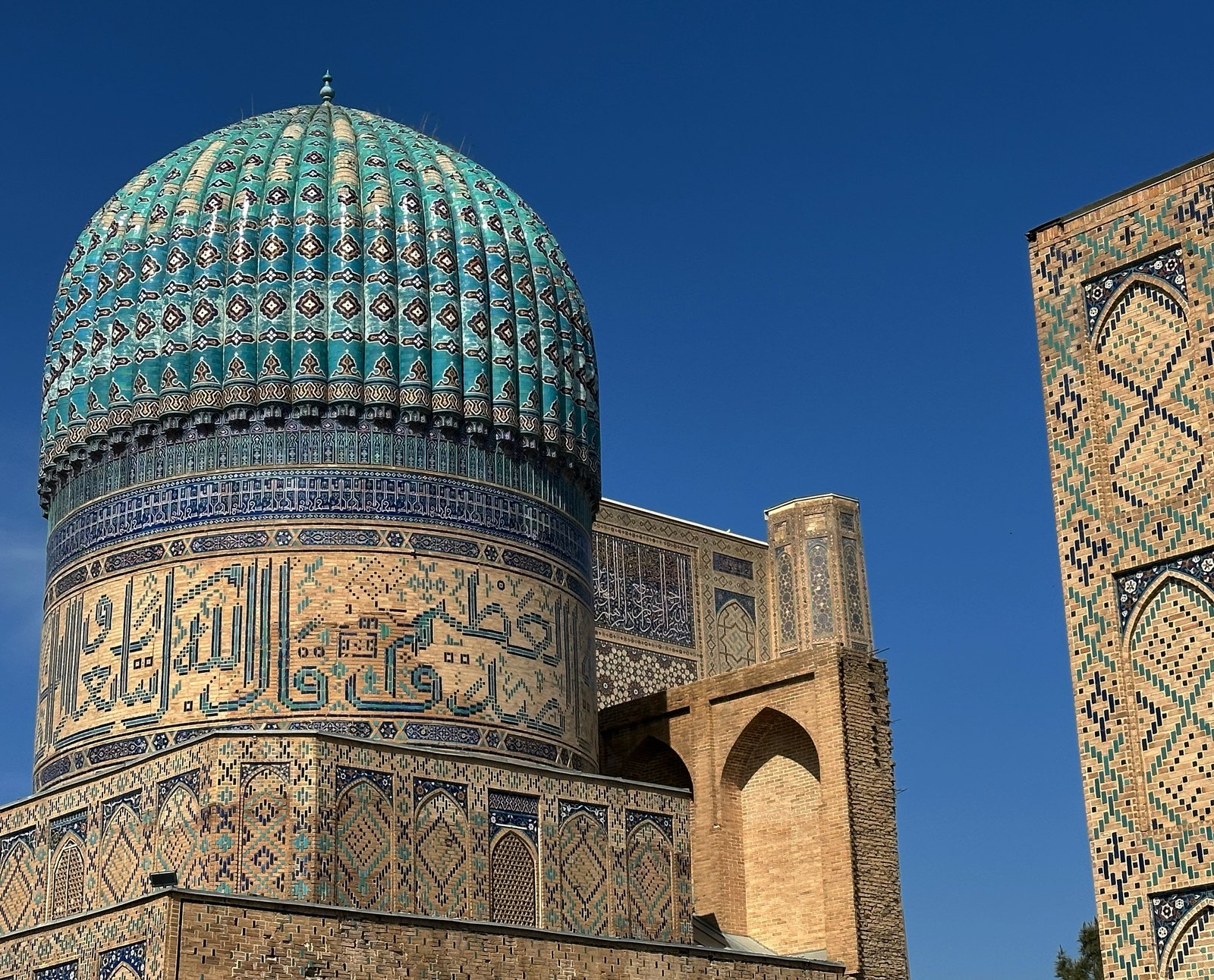
The Registan: Uzbekistan’s Iconic Masterpiece
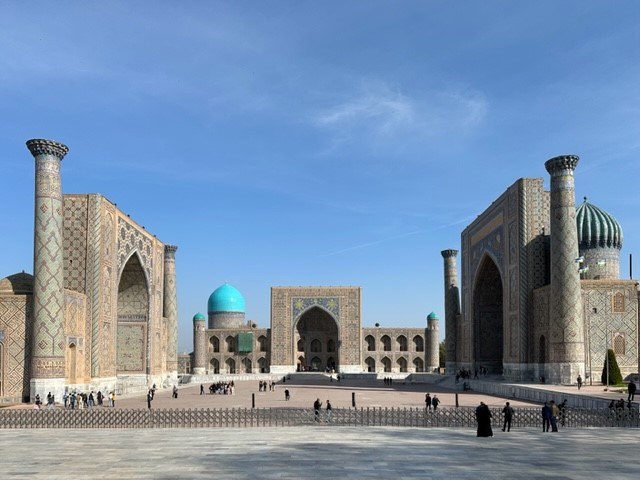
Registan Square: the grand architectural ensemble composed of Ulugh Beg, Sher-Dor, and Tilla-Kari Madrasas.
The absolute center of Samarkand is The Registan, a recognized masterpiece of Islamic architecture and the country’s most celebrated landmark. This colossal public square is framed on three sides by towering, intricately tiled madrasas (Islamic academies) dating from the 15th to the 17th centuries:
- Ulugh Beg Madrasa (1417–1420): Built by Timur’s astronomer grandson, Ulugh Beg, adorned with geometric starburst tile mosaics reflecting his passion for celestial sciences.
- Sher-Dor Madrasa (1619–1636): Famous for its rule-breaking figurative mosaics depicting stylized tigers hunting stags beneath human-faced rising suns.
- Tilla-Kari Madrasa (1646–1660): The “gilded” madrasa, designed to serve as both an academy and Samarkand’s grand Friday mosque.
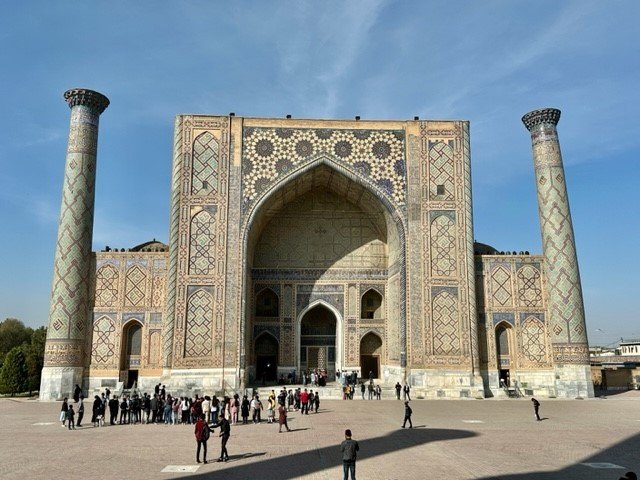
Ulugh Beg Madrasa: geometric blue mosaic tilework.
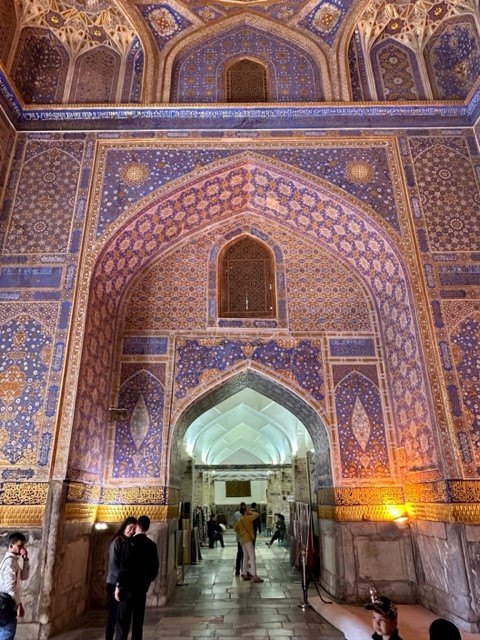
Tilla-Kari: gold-leaf gilded dome and trompe l’oeil ceiling.
Advisor Field Note: Don’t Miss the Tilla-Kari Interior
Each madrasa has an expansive open courtyard lined with two levels of arched student cells, where Islamic scholars lived and studied centuries ago—now occupied by master woodcarvers, ceramic painters, and silk merchants. Whatever you do, do not miss entering the mosque interior of the Tilla-Kari Madrasa. The dome is flat, yet painted with thousands of gold-leaf floral patterns that create a breathtaking three-dimensional trompe l’oeil illusion of a soaring, concave heavens. It is the most magnificent interior in Central Asia.
Bibi-Khanym Mosque & The Shah-i Zinda Necropolis
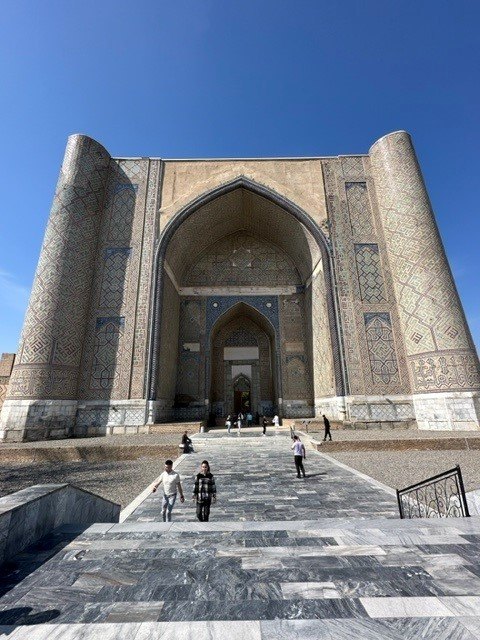
The colossal entrance portal (iwan) of Bibi-Khanym Mosque, once the largest mosque in the Islamic world.
Fluted azure cupolas and soaring minarets of the Bibi-Khanym complex.
Bibi-Khanym: A Monument of Imperial Ambition
A short, pleasant walk from the Registan brings you to Bibi-Khanym, originally commissioned by Timur in 1399 upon his triumphant return from Delhi. Timur intended this mosque to surpass every religious structure on Earth, deploying 90 elephants to haul marble from quarries in India. With its massive 35-meter-high arched portal, towering cupolas, and vast courtyard once holding thousands of worshipers, it remains one of Samarkand’s most emotionally striking vistas.
Shah-i Zinda: The “Living King” Avenue of Turquoise Tombs
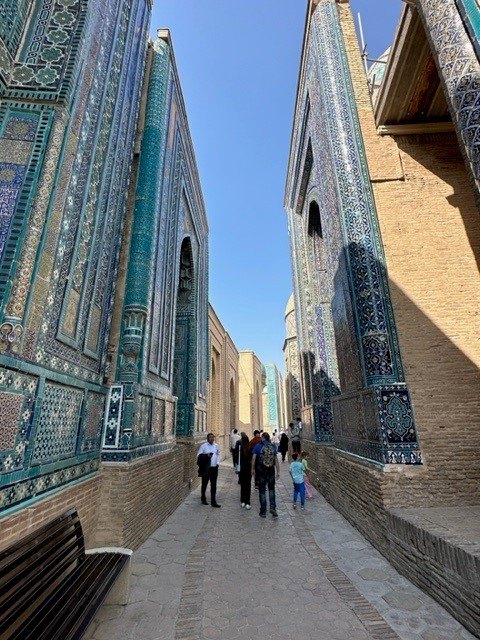
The narrow corridor of Shah-i Zinda, framed by turquoise majolica tombs.
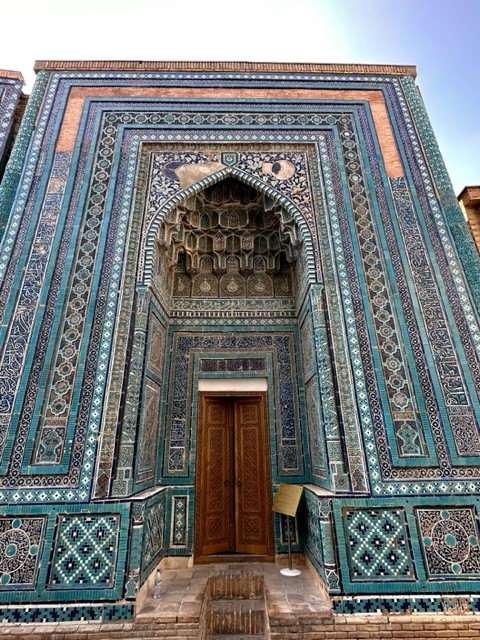
Intricate lapis lazuli, turquoise, and cobalt tile carvings.
The other star attraction in Samarkand is Shah-i Zinda (which translates as “The Living King”). Located about 20 minutes from the city center on the slopes of ancient Afrosiab, this sacred necropolis contains more than twenty unique mausoleums dating from the 14th and 15th centuries. Here lie Timur’s sisters, wives, generals, and nobles, clustered around the 7th-century shrine of Kusam ibn Abbas.
Walking down the narrow, shaded avenue between these soaring blue tombs is like entering a kaleidoscope. The variety of ceramic techniques—carved glazed terracotta, painted majolica, intricate girih geometric motifs, and flowing Arabic calligraphy—is unmatched anywhere in the world. Each tomb is distinct, bathed in shimmering shades of sky blue, lapis, and rich turquoise.
Afrosiab, Siyob Bazaar & Samarkand by Night
Beyond the primary triumvirate of the Registan, Bibi-Khanym, and Shah-i Zinda, Samarkand offers several other essential cultural discoveries:
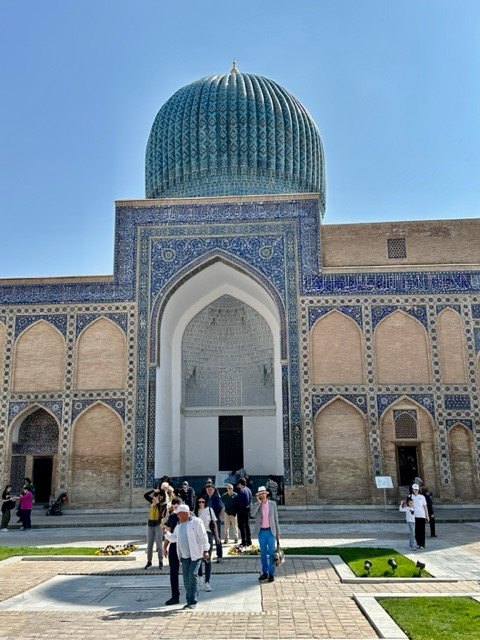
- Gur-i Amir (Tomb of Timur): Crowned by a distinct fluted azure dome, this intimate mausoleum contains the tomb of Timur the Great, marked by a massive slab of dark green Mongolian jade, alongside his sons and his beloved grandson Ulugh Beg.
- Afrosiab Citadel & Museum: Archaeological excavations of pre-Mongol Samarkand, housing the remarkable 7th-century Sogdian wall murals depicting Silk Road royal envoys bearing silk, pearls, and exotic gifts.
- Siyob Bazaar: For a vibrant immersion into daily Uzbek life, wander through this sprawling open-air market located adjacent to Bibi-Khanym. Stalls overflow with mounds of golden raisins, dried apricots, mountain walnuts, fragrant spices, and the legendary Samarkand non—heavy, dense, beautifully stamped bread that stays fresh for weeks and is considered sacred in Uzbek culture.
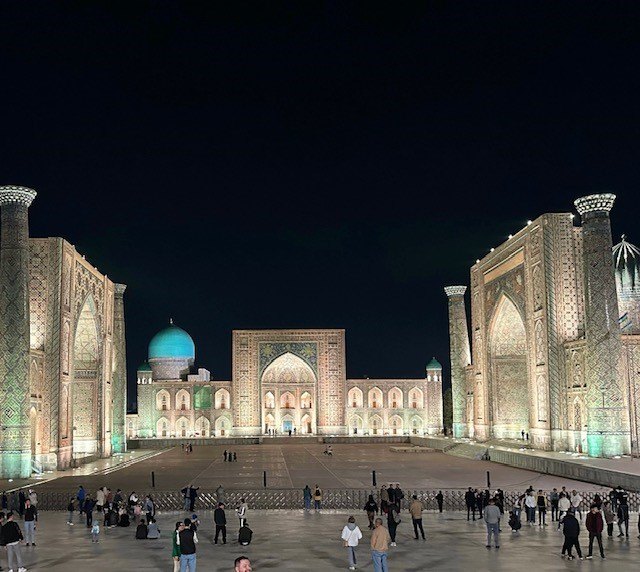
Registan Square illuminated in golden light after nightfall.
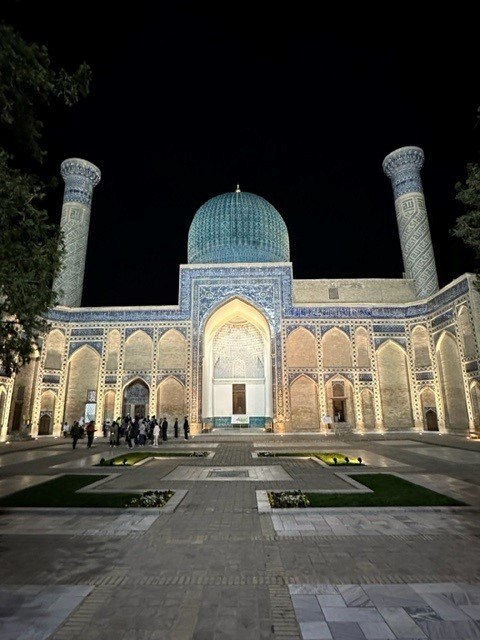
Bibi-Khanym Mosque under dramatic nighttime illumination.
Advisor Tip: Experience Samarkand After Dark
After dinner, be sure to arrange for your private driver to take you back to Registan Square and Bibi-Khanym. The major monuments are bathed in theatrical, golden floodlights against the deep midnight blue sky. Seeing the turquoise tilework illuminated without daytime crowds is an unforgettable highlight.
Where to Stay: Samarkand Regency Amir Temur
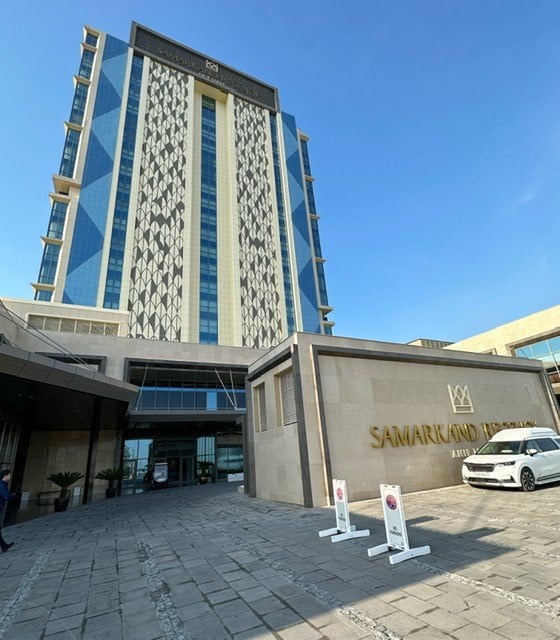
Samarkand Regency Amir Temur: the premier luxury property in Uzbekistan.
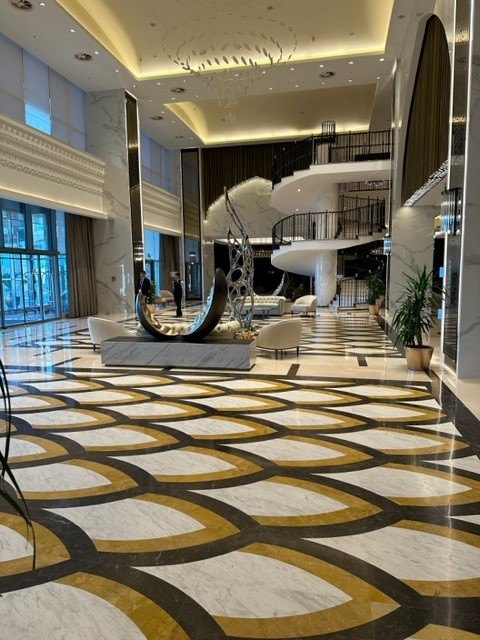
Sophisticated contemporary luxury interior at the Samarkand Regency.
Historically, luxury travelers to Central Asia were challenged by modest Soviet-era accommodations. That dynamic has completely changed with the opening of the Samarkand Regency Amir Temur—the undisputed premier hotel in Uzbekistan and the first Leading Hotels of the World (LHW) property in Central Asia.
Located within the master-planned Silk Road Samarkand resort district, approximately 20 minutes’ drive from the city center (and exceptionally convenient to the Shah-i Zinda site), the property offers:
- 207 Generous Guestrooms & Suites: Starting at an expansive 350 sq. ft. and featuring Italian marble bathrooms, plush bedding, bespoke Silk Road textiles, and floor-to-ceiling panoramic windows.
- World-Class Dining: Two signature restaurants offering authentic Uzbek specialties and refined Mediterranean cuisine, complemented by a chic rooftop cocktail lounge overlooking the rowing canal.
- Wellness & Relaxation: An extensive European-style luxury spa, comprehensive fitness center, and a heated 75-foot indoor swimming pool—perfect for rejuvenating after a day walking the historic stone squares.
Uzbekistan: Practical Advisor Field Advice
For travel advisors planning custom Central Asia itineraries for discerning clients, here are strategic logistical recommendations from Ignacio Maza:
1. When to Visit: Navigating the Continental Climate
The best seasons to visit Uzbekistan are Spring (March to May) and Autumn (September to November). Continental desert climates produce severe extremes: winters are bitterly cold with temperatures plunging to 10°F (−12°C), while mid-summer (July and August) brings blistering dry heat regularly exceeding 105°–110°F (40°–43°C). Ignacio visited in March and experienced pleasant, sunny days in the 60s°F with cool, refreshing evenings.
2. Money & Currency Matters
The national currency is the Uzbek Som (UZS) (approximately 1 USD = 11,600–12,500 UZS).
- Bring Crisp, New USD Cash: Money changers and banks strictly require uncreased, unmarked US dollar bills (preferably printed after 2013) with zero tears or ink marks.
- ATMs: USA-based bank ATM cards work smoothly in hotel lobby ATMs (Kapital Bank machines are reliable for withdrawing Som or US dollars).
- Credit Cards: Visa and Mastercard are accepted at major hotels and fine restaurants, but cash is king for bazaar shopping, ceramics, silk carpets, and driver/guide gratuities.
3. High-Speed Rail & Internal Transit
The modern Afrosiyob High-Speed Train (manufactured by Spain’s Talgo) connects Tashkent, Samarkand, and Bukhara at speeds up to 155 mph (250 km/h), transforming a grueling 6-hour highway drive into a smooth 2-hour rail journey.
Key Rail Booking Tip:
Always upgrade your clients to Business Class or VIP Class on the Afrosiyob train. The price difference over standard economy is negligible (often less than $20–$35 USD), while providing vastly superior 2+1 seating, generous luggage racks, complimentary tea and snack service, and a tranquil atmosphere. The same recommendation applies for domestic flights on Uzbekistan Airways.
4. Visas & Entry Requirements
US and Canadian citizens require an entry visa, which is easily obtained via Uzbekistan’s official e-Visa portal prior to departure (valid for 30 days of single or multiple entry).
5. Recommended Luxury DMC: Exeter International
Ignacio personally traveled with Exeter International, the premier luxury tour operator and destination specialist for Central Asia and Eastern Europe. Exeter possesses deep on-the-ground infrastructure, exceptional English-speaking scholar-guides, vetted private Mercedes vehicles, and VIP access to private palace courtyards.
6. International Flight Connectivity: Turkish Airlines
The most convenient, seamless flight routing from North America into Uzbekistan is aboard Turkish Airlines via Istanbul. Turkish Airlines offers direct wide-body service into Tashkent, as well as direct flights into Samarkand, Bukhara, and Urgench (Khiva). Travelers can also take advantage of Turkish Airlines’ complimentary Istanbul stopover program, adding 2 to 3 nights in Turkey to their Silk Road itinerary.