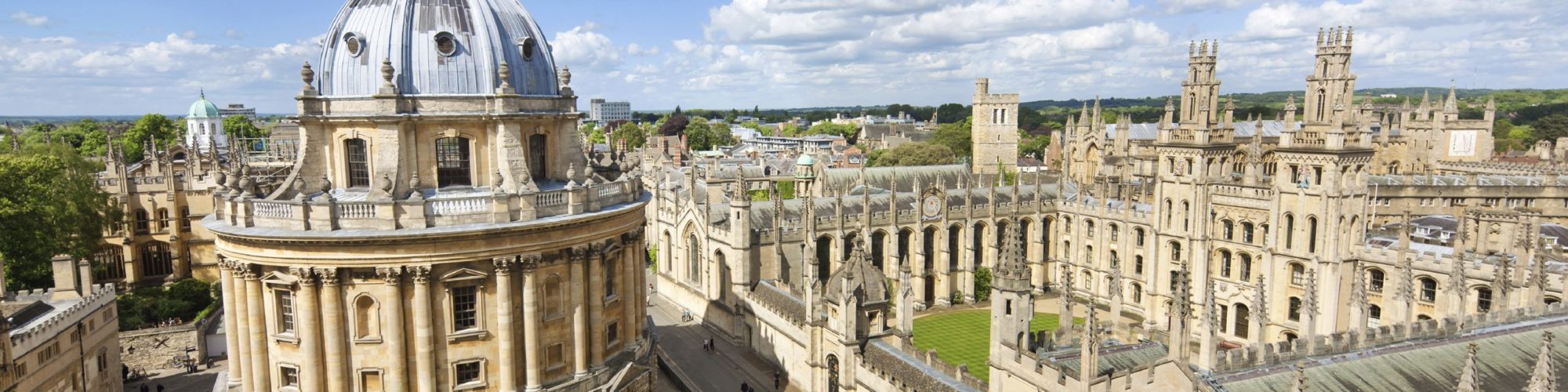
Home to the U.K.'s oldest university, Oxford is eccentric, engaging and personable—epitomizing the spirit of Old England in many ways. The "city of dreaming spires" claims the world's densest concentration of Gothic architecture. Towers, battlements and domes crown the compact center, which is fringed by watery parklands. Many streets and cobbled alleys are pedestrian, making this a pleasant place to stroll.
The university, which is documented as far back as the end of the 12th century and may be older, is the oldest university in the English-speaking world. It has 39 colleges, each with its own traditions, history and grand edifices. The "ivory towers" are sprinkled throughout the city. Among their highlights are Christ Church's quadrangle and cathedral; the Bodleian Library and its rotund Radcliffe Camera; Hertford College's Bridge of Sighs and Magdalen (pronounced MAUD-lin) College. During spring exams, students still wear mortarboards and trailing dark robes over semiformal clothes.
However, the city also has a modern edge. Runner Roger Bannister broke the four-minute mile in May 1954 in East Oxford, and indie bands Supergrass and Radiohead later launched there. The Said Business School rises sleek above the train station.
"A city built on books," was how author Jan Morris described Oxford. Publishing continues to thrive in the city that inspired Alice in Wonderland, The Lord of the Rings, The Wind in the Willows and, more recently, the His Dark Materials trilogy by Philip Pullman.
Many former Oxford students have become literary lions: Dr. Samuel Johnson, John Donne, Percy Shelley, T.S. Eliot, John Galsworthy, John Buchan, W.H. Auden, Oscar Wilde, Graham Greene, Dorothy Sayers, Robert Graves, A.E. Houseman and Evelyn Waugh, among others. Iris Murdoch taught philosophy at St. Anne's College in addition to her writing.
Visitors frequently underestimate this destination, merely day-tripping between London and Stratford-upon-Avon. Yet Oxford merits leisurely exploration of everything from the ancient colleges to the world-class Ashmolean Museum, countryside rambles and picnic boat-excursions on the River Thames.
With its central position and excellent transport options, Oxford makes a more peaceful alternative to London as a sightseeing base, with day access to such places as London, Bath, Stonehenge and Stratford-upon-Avon.
Best Travel Agents
Best Carnival Cruise Line Travel Agents and Deals
We are your premier destination for all things Carnival Cruise! As certified experts in Carnival Cruise Line travel, we pride ourselves on offering the best deals and personalized service to make your cruise vacation unforgettable.
Must See or Do
Sights—The view of Oxford's cityscape and spires; Christ Church Cathedral and Great Hall; the Bodleian Library.
Museums—The Ashmolean Museum of Art and Archaeology; dinosaurs and dodos at the Oxford University Museum of Natural History.
Memorable Meals—Cozy booths and historic atmosphere at The Eagle and Child; British traditional dishes at Gee's Restaurant; lavish, organic French fare at nearby Le Manoir aux Quat' Saisons; ethnic restaurants on Cowley Road.
Walks—A walk along the Thames Path, with views of the river and charming countryside; the University of Oxford Botanic Garden; wandering the historic city center.
Especially for Kids—Totem poles, shrunken heads and other oddities at the Pitt Rivers Museum; punting on the Thames; Oxford Science Live gallery; weekend family sessions at various university-affiliated museums.
Geography
Just 55 mi/90 km northwest of London, Oxford lies on the wide plain of the River Thames. The Thames and its tributary the Cherwell (pronounced Charwell) flow through the city. The Thames between Iffley Lock and Folly Bridge, where rowing events take place, is referred to as the Isis, a shortened version of the Latin for Thames, Tamesis. The Oxford Canal cuts a straighter course through the length of the city.
The historic center is compact and covers a diameter of just over 1 mi/1 km. The industrial zone, known as Cowley, is about 3 mi/5 km southeast of downtown. Jericho, immediately northwest of the town's center, was once a working-class, redbrick residential area fringing factories and warehouses. Today it's gentrified into a popular neighborhood for dining and entertainment. Wolvercote and Iffley, 4 mi/6.5 km to the north and south, respectively, are historic villages that were long ago engulfed by the expanding city.
Oxford's east and west sides are fringed with parks and gardens. Stretching to the northeast along the banks of the Thames, Port Meadow is believed to be England's largest expanse of common land; livestock have grazed there since the Bronze Age. It is prone to flooding in winter and spring.
History
The Saxons first settled this strategic location in the heart of southern England. The Normans later consolidated the town's position by slightly adjusting the street plan and building a castle (the mound remains) with a strong wall around it.
Little survives of the Normans except the 12th-century Christ Church Cathedral, standing on the possible site of the Saxon-era convent of St. Frideswide. Among the oldest monuments are the 11th-century Tower of St. Michael-at-the-Northgate and part of the town wall, dating from 1226, around the garden of New College.
England's first university was founded there after Oxford had established itself as a center for learning in the 12th century. The town's churches and colleges, built of honey-colored stone and mellowed by time, are its crowning glory. Today, the city remains a center of learning as it continues to attract technology companies to its fringe communities.
Potpourri
Oxford received its nickname, The City of Dreaming Spires, from the poem "Thyrsis" by Matthew Arnold, a professor of poetry at the university in the mid-1800s.
Iffley Lock is on the site of the ford from which the city gets it name.
J.R.R. Tolkien, C.S. Lewis and other literary greats would regularly meet at The Eagle and Child to read and discuss excerpts from their books. A plaque marks their favorite nook.
Charles Lutwidge Dodgson (Lewis Carroll) taught mathematics at Christ Church. He wrote his Alice in Wonderland stories after taking the dean's daughters, one named Alice, out on the river for an afternoon.
The Rev. W.A. Spooner, whose habit of transposing the first letters of words gave us the term spoonerism, was warden of New College 1903-24. Among his spoonerisms was this, addressed to a student: "You have hissed my mystery lectures; you have tasted a whole worm."
The Harry Potter movies have filmed in several Oxford locations. The Bodleian Library served as Hogwarts' library, and the Great Hall at Christ Church inspired the school's dining hall.
Oxford has been popular with other filmmakers, too. Among its cinema-location credits are Shadowlands, King Arthur, Charlie and the Chocolate Factory, Bridget Jones, Gosford Park, Eyes Wide Shut and numerous Bond flicks, including Tomorrow Never Dies, with New College in the supporting role of backdrop to the secret agent.
Eighteenth-century astronomer Edmund Halley first observed the comet that bears his name from the rooftop observatory of his house in New College Lane.
An Oxford Blue is not only a delicious cheese and an ice cream sold in the Covered Market, but also a sportsperson who has represented the university against Cambridge (known in Oxford as "the other place").