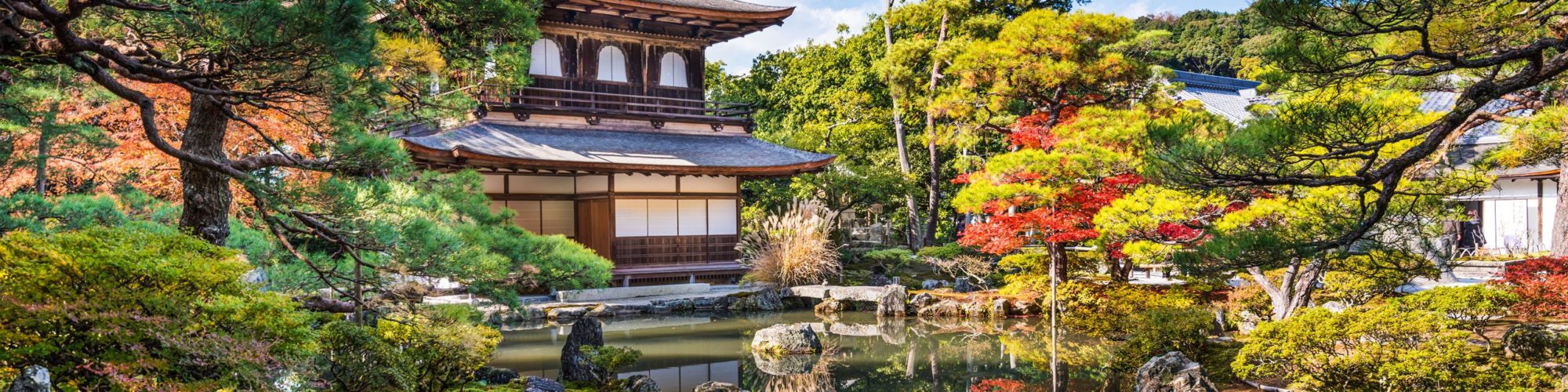
If you can visit only one city in Japan, Kyoto is the one. This ancient city, 30 mi/50 km northeast of Osaka, was the capital of Japan for more than 1,000 years and still is considered the country's spiritual capital. Three thousand shrines and temples dot the city, including three shrines and 14 temples on the UNESCO World Heritage list. That list is far from all-inclusive, and many excellent places that might be the star attractions of other cities crowd the streets of Kyoto. It is a center of Japanese Zen and has five huge Zen monastery complexes where serious students still sit in meditation.
Kyoto is also the nation's capital of traditional arts. Whether your interest be in pottery, textiles, dance, the tea ceremony or any of the other innumerable arts, Kyoto has excellent galleries, museums, shops and tea houses. Japanese people from the countryside and foreign students flock there to learn under the great masters. Much of what is considered Japanese haute cuisine was developed there too, as an offshoot of the tea ceremony.
Kyoto is Japan's heartland of history. With 1,300 years of tumultuous existence, the city's past intrudes upon the present day as in few other Japanese cities. In Gion, you can spot a geisha (or geiko, as they are called in Kyoto), one of the last hundred or so in Japan, slipping down a side-street to entertain rich guests with witty conversation, dance or music. A shopping arcade may suddenly fill with discordant clanging music as a shrine festival passes among the shoppers, or you may hear the long chant as Zen monks pass through the neighborhood, calling for alms.
Kyoto is an understated city that might disappoint visitors at first (at first glance, it is a large city with modern buildings that might not align with one's original perception); its charm lies in small details, pocket gardens, tiny traditional restaurants and refined artwork.
Best Travel Agents
Best Carnival Cruise Line Travel Agents and Deals
We are your premier destination for all things Carnival Cruise! As certified experts in Carnival Cruise Line travel, we pride ourselves on offering the best deals and personalized service to make your cruise vacation unforgettable.
Must See or Do
Sights—City-wide views from Kiyomizu Temple; the red gates of Fushimi Inari; Zen meditation in Nanzen-ji Temple; the expansive gardens of the Imperial Palace Park.
Memorable Meals—Walking and snacking in the Nishiki Food Market; exquisite kaiseki dishes at Gion Karyo; hearty udon noodles at Omen; rich and succulent eel at Unagi-ya Hirokawa.
Late Night—Looking for geisha in Gion; a candlelit tea ceremony at Joukeian.
Walks—The short hike up Mount Daimonji; the cherry-tree-lined path of Philosopher's Walk.
Especially for Kids—Arashiyama Monkey Park; Shinkyogoku Shopping Arcade.
History
After Japan's capital was moved from Nara to Kyoto in 794, the imperial court gradually weakened. Following a long power struggle, the strongest warlord seized power from the Kyoto court and assumed the title of shogun. From this point on, the emperors were marginalized and the country was ruled by a succession of shoguns. Civil war left the country exhausted, and Kublai Khan's Mongols twice tried to take advantage of this weakness. Two invasions were cut short when the fleets were destroyed by typhoons (miraculous occurrences attributed to the kamikaze, or divine protective winds).
Until the 16th century, large areas of Japan remained in the hands of feuding warlords. However, the first Tokugawa shogun completed the unification of the country and established his administrative base in Edo (present-day Tokyo), while the emperor's court remained in Kyoto. The shogun's descendants controlled Japan from 1600 to 1868 (usually known as the Edo Period) and during this period, Kyoto's political influence decreased further. However, the relative peace of the Edo Period was a boon for merchants and artisans, and Kyoto flourished.
Potpourri
Shinto has 88,000 gods, more than any other religion in the world. During the month of November, the gods take a break from their busy schedule and get together for a conference at the Izumo Taisha Shrine in Shimane Prefecture.
The Byodin Temple in Uji, near Kyoto, features on the back of Japan's 10-yen coin.