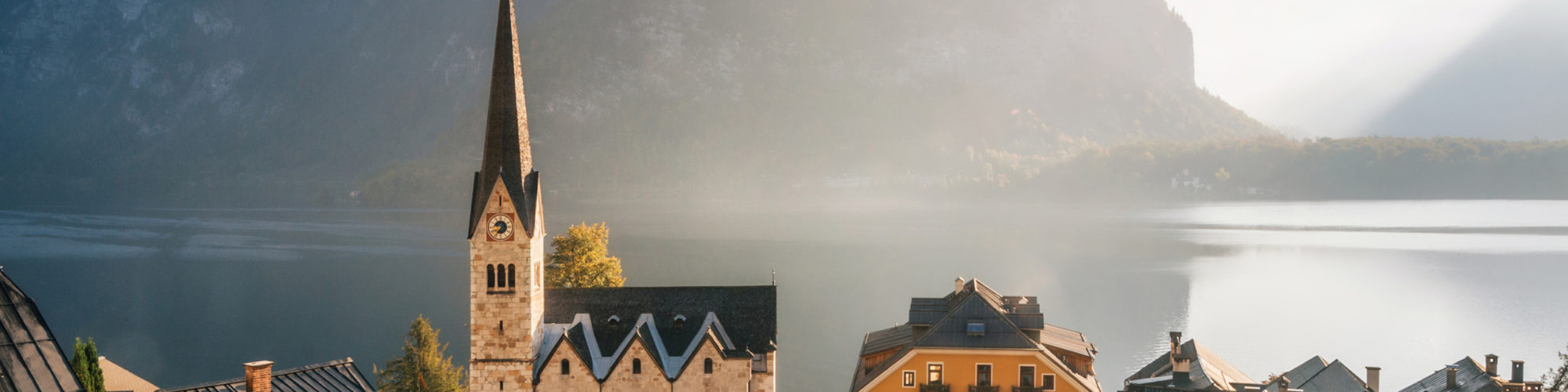
Austria is full of rich cultural offerings and traditions, many dating from when Vienna was the seat of a powerful empire. There's plenty of music, too. This is the country of Mozart and Johann Strauss, music festivals in Alpine settings, and the original setting of The Sound of Music.
Austria also offers fairy-tale castles and skiing, spectacular scenery and Sacher torte. The grandeur of Vienna's imperial buildings matches Austria's huge romantic streak and its passion for rituals.
Whether in the coffeehouse, the church or the grand ballroom, Austrians seem to blend a kind of Italian romanticism and charm with a Germanic love for order. You can experience that romanticism with something as simple as a hike through the mountains of the Tirol—or as spectacular as a visit to Vienna's Spanish Riding School, where you can see the magnificent Lipizzaner stallions perform their gravity-defying "airs above the ground."
Geography
Mountains and the Danube River Valley, which are covered in beech and pine forest, dominate the country's terrain. More than 70% of the country is mountainous, with the eastern Alps covering most of the territory. Only in the northern plain (around Vienna) and in the southeast (near Graz) is there relatively flat land. History
Thousands of years ago the Celts were the original settlers, mining the area for iron. Romans followed, and then Huns, Ostrogoths, Lombards, Turks and Bavarians. Vienna marked the farthest advance of Islam into Europe, with the Ottoman Turks besieging Vienna twice, in 1529 and 1683.
For much of its history, Austria has been synonymous with the Habsburgs, the continent's most influential dynasty and one of the longest-lasting. They retained power for 700 years (1218-1918) through empire-building marriages and a series of pragmatic leaders. At the height of the country's glory, its great emperors controlled Europe from Spain to Poland and from Holland to modern-day Romania.
Empire-building fostered other kinds of creativity: The nation was the music center of Europe during the 18th century and a hotbed of literature, art and science in the 19th and early 20th centuries. Mozart, Haydn, Strauss, Beethoven, Brahms, Kafka, Klimt and Freud are just a few of the luminaries who lived in Austria during the late imperial era.
At the end of World War I, the multiethnic Austro-Hungarian Empire was broken up, creating Czechoslovakia, Hungary and Romania. Other territories became parts of Poland, Italy and the then-Federal Republic of Yugoslavia. Austria became the small German-speaking country we know today. The country slowly emerged from its imperial past via an uneasy and unsatisfactory alliance with Germany during the Nazi period. After World War II, Austria became one of the most highly developed European countries, and in 1995 it joined the European Union.
Although Vienna is no longer the capital of a diverse multiethnic empire, the city and the nation still retain their international style. Thousands of immigrants from southern and eastern Europe and the Middle East now call Austria home, as does one of the three main headquarters of the United Nations.
Snapshot
Austria's main attractions include skiing, ice and mountain climbing, modern cities, classical music and opera, museums, architecture, palaces, cultural performances, white-water kayaking, health spas, hiking, shopping, Alpine scenery, mountain lakes and the Danube.
Nearly everyone will find something satisfying about Austria. The only people who won't are those particularly interested in visiting numerous sandy beaches.
Potpourri
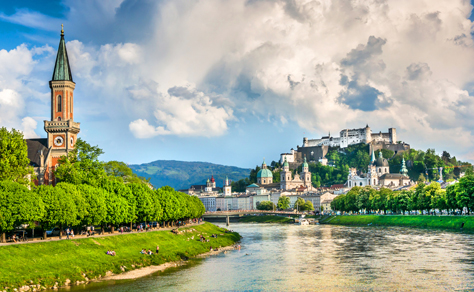
Many of the sights in and around Salzburg were featured in the 1965 movie The Sound of Music. Those familiar with the film will recognize the Residenz, Mozartplatz, the Dom, Mirabell Palace and Hellbrunn Castle.
With such a developed coffeehouse culture, it's no surprise that the Viennese introduced coffee and croissants (called kipferl in Austria) to Europe. In 1683, the story goes, they and their allies attacked Turkish invaders so suddenly that the Ottoman troops left behind their meals of coffee and bread shaped like a crescent (a symbol of Islam).
Vienna comes alive during ball season. Between January and February, there seems to be a different ball every day. Every group, union and organization in the city hosts its own. The most popular are the Opernball (Opera Ball) in the Staatsoper, the Kaffeesiederball (Coffee Ball) in the Hofburg, the Blumenball (Flower Ball) in the Rathaus, the Kaiserball (Imperial Ball) in the Hofburg, the Zuckerbackerball (Sugar Ball) in the Austrian Center Vienna and the Vienna Philharmonic Ball in the Muzikverein. Some of the balls are open to the public. Dressing up is expected. Contact the Austrian National Tourist Office for additional information.
Admont Abbey in Styria, which dates from the 11th century, has what many regard as the most beautiful rococo library in all of Europe.
Vienna is the birthplace of Jugendstil, the Austrian art-nouveau movement. Gustav Klimt and Egon Schiele are two of the best-known Jugendstil painters. Examples of Jugendstil architecture are Otto Wagner's Karlsplatz Stadtbahnhof and Majolikahaus at Linke Wienzeile 40.
Vienna has three Danubes: Alte Donau, or Old Danube, a lake for rowing and sailing; Neue Donau, the new, straightened-out channel for barge traffic; and the Donaukanal, which runs through the center of the old town.
In the province of Styria, green salads are commonly dressed with a mix of vinegar and local pumpkinseed oil, called kurbiskernol, for a unique taste. Produced industrially or by farmers locally, the oil can be purchased at supermarkets or smaller markets within Styria.
The song "Silent Night" was written in the village of Oberndorf, near Salzburg.