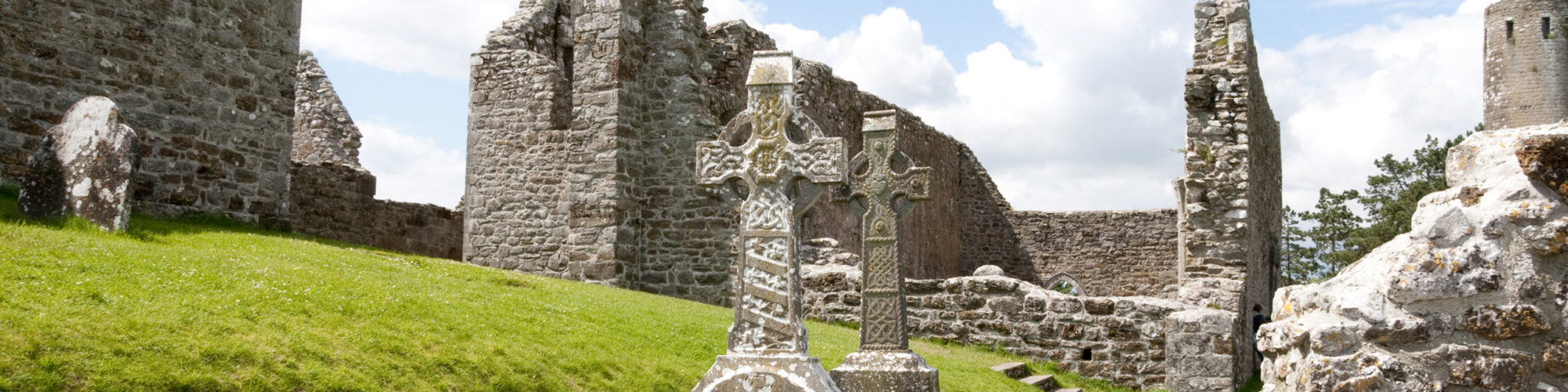
Travelers looking for charm, friendly people, solid service without a "touristy" feel and plenty of places to explore should plan a vacation to Ireland. In addition to pubs and Riverdance-style step dancers, you also can find local musicians, stunning scenery, ruins and historical sites, golfing and other outdoor activities to enjoy at a relaxed pace.
Nearly everyone will find something to enjoy in Ireland, be it the green countryside, Irish whiskey, shopping, bicycling tours or wandering sheep. Traditional culture still thrives, and the Emerald Isle's people and way of life have not been significantly altered by modern trends. Travelers will find good service, lots of accommodation options and little crime aimed at visitors. Even the souvenir shops seem rather low-key.
Once, we asked an old man for the Irish-language equivalent of manana ("tomorrow" in Spanish). He paused for a moment, then took off his cap and scratched his head, pondering the question. Then he took an old, battered pipe from his pocket, a knife from the other and started cleaning out the bowl. When he had done that, he rummaged in his pockets and produced a plug of tobacco. He cut off a few slices and placed them in the pipe, tamping them down with the blade of his knife.
Then he searched his pockets once again, produced a box of matches and proceeded to light his pipe. Once he had it going well he took off his cap and scratched his head once more. Putting the cap back on, he smiled at us and said, "In all truth, sir, I do not think that there is a word in all of the Irish language for expressing such urgency."
Take your time when traveling around the country. Although it's possible to drive the length of Ireland in less than a day and to traverse the width of the country in a few hours, we prefer to settle in and explore a particular region, whether on foot, on horseback or behind the wheel—mindful, of course, of wandering sheep on small back roads.
Geography
Ireland is an island off the western coast of the U.K., from which it is separated by the North Channel, St. George's Channel and the Irish Sea.
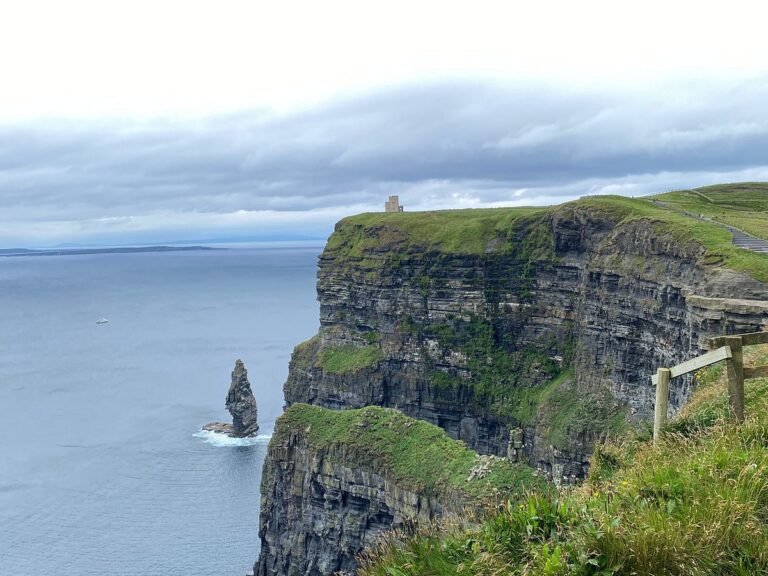
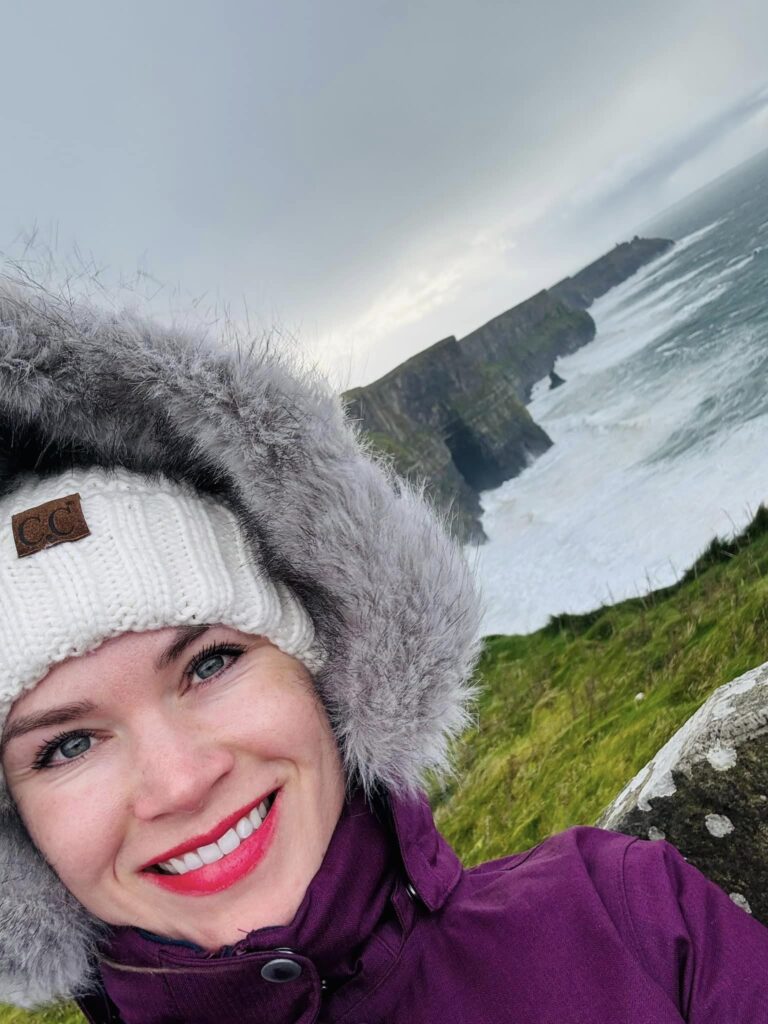
The coastal areas of Ireland tend to be mountainous and rugged, especially on the western side of the island, which wards off the Atlantic Ocean with an almost unbroken line of cliffs and mountains.
By contrast, the central portion is relatively flat, fertile farmland dotted with bogs.
History
The genial nature of the Irish is surprising considering their country's history of conflict: The island has drawn wave after wave of invaders.
Celtic tribes from Europe led one of the early onslaughts, arriving around 300 BC and wresting control from the people who were already living on the island. The Celts were gradually converted to Christianity beginning in the AD 300s (St. Patrick being a prime motivator), and during the Dark Ages, scholars based at Irish monasteries helped preserve important writings from throughout western Europe.
Viking plunderers menaced Ireland beginning around AD 700, and some of the Norse invaders eventually settled on the island. Three centuries later, English warriors intervened in a dispute between two Irish kings, beginning England's long involvement in Ireland.
Religion played a key role in the struggles: The majority of the Irish were Catholic, and they were often at odds with their Protestant English rulers. The fiercest and most bitter battles occurred in the mid-1600s, when Oliver Cromwell reasserted English control by shedding much Irish blood, seizing the lands of his opponents and desecrating Catholic cathedrals all across the land.
The horrific potato famine of the mid-1800s killed a million people in Ireland and forced another million to leave the country. It also intensified resistance to English rule, because many believed English leaders should have done more to aid the starving people in Ireland. A long and bloody struggle for independence culminated in the Easter Rising of 1916 and the subsequent Anglo-Irish War, which came to an end in 1921.
As a part of the agreement that ended the war, the majority of the island became an independent country—the Republic of Ireland (Eire). The northeastern sixth of the island, which has a Protestant majority, remained part of the U.K. as Northern Ireland.
In 1973, Ireland joined the European Economic Community (now the European Union), which gave it a tremendous boost through expanded trade opportunities and economic investment. By the late 1990s, when many technology firms opened offices there, it became the fastest-growing economy in the industrialized world.
This rapid rise from poverty to prosperity was known as the Celtic Tiger. Signs of its wealth were evident in the capital and in new construction around the country. In 2002, Ireland adopted the European currency, the euro.
Property development in the boom years had comprised much of Ireland's prosperity, leaving the country vulnerable when housing prices tumbled in the global economic crash of 2008-09. The subsequent banking collapse and debt crisis led to Ireland's becoming the second Euro-zone casualty after Greece, and it received a bailout of 85 billion euros from the EU and IMF in November 2010.
During the resulting period of austerity conditions, Ireland quietly reduced its deficit and improved its exports. Three years later, it successfully exited the bailout, and by 2014, it was once again the fastest growing economy in the EU.
Having recently celebrated the centenary of the Easter Rising (1916) which set it on the road to independence, the country continues to benefit from rising employment and an expanding economy.
Snapshot
The country's main attractions are stunning coastal scenery, charming people, traditional music and dance, excellent golfing, horse racing, fishing, fine theater, bird-watching (for puffins, terns and other northern sea birds), historical sites and ruins, lush gardens, shopping and legendary Irish pubs (where Guinness stout and Irish whiskey flow freely).
Ireland will appeal to almost everyone. However, the same natural elements that make the countryside so green make the weather cool and damp—it rains and mists a lot. The weather, even in summer, can be damp and chilly, but then, no one goes to Ireland for the weather. Although there are beautiful hotels, not all areas have deluxe accommodations.
Potpourri
What's that smell? It's probably the smoke from burning peat, which is still a popular fuel in Ireland. In some rural areas, you may see piles of peat bricks drying beside the bogs where they were cut.
The first Europeans to reach the New World may have been a group of Irish monks in the sixth century, led by St. Brendan the Navigator, who sailed across the Atlantic looking for a new land he had seen in a vision. No archaeological evidence exists, but in 1976 the English explorer Tim Severin made the legendary voyage in a replica of St. Brendan's boat and proved it was possible.
The term "honeymoon" comes from the days when mead—a drink made from fermented honey—was Ireland's favorite alcohol. According to tradition, newlyweds were given enough mead to toast each other until the next full moon.
The former headquarters of the pirate queen Grace O'Malley (Granuaile) is on Clare Island. For 40 years she commanded fleets and armies, leading rebellions against Queen Elizabeth I of England. Defeated, O'Malley was sent to London to pay homage to the queen. The Irish say it was a meeting of equals.
Thousands of people make the pilgrimage to climb Ireland's most sacred mountain, Croagh Patrick (Cruach Phadraig) in County Mayo. The annual climb takes place on Reek Sunday (the last Sunday in July).
County Kerry was the first part of Europe sighted by Charles Lindbergh in his 1927 solo flight across the Atlantic. Using a compass and dead reckoning, the aviator was less than 3 mi/5 km off course after his long ocean crossing.
The Transatlantic Cable, a forerunner of the internet, came ashore at Valencia Island in County Kerry. Because of this, IRA members in New York heard of the Easter Rising in Dublin before the news reached the U.K. government in London.