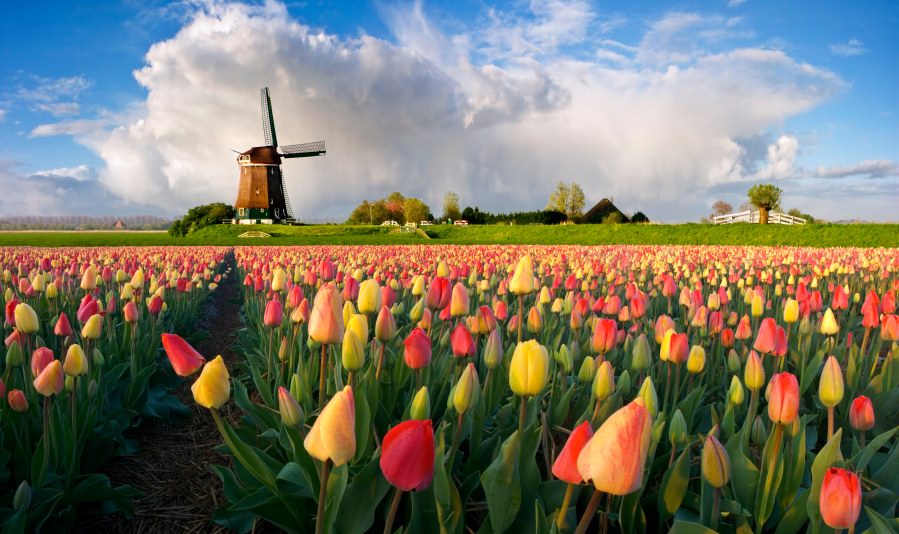
If you think of the Netherlands solely as a tranquil still life by Vermeer, you may be in for a surprise. Much of its countryside—with cows grazing in fields near canals and old windmills—does suggest the timeless serenity captured by so many Dutch painters, but in its cities you'll find a more unexpected sort of harmony—one that balances tidy traditional architecture with a very modern point of view.
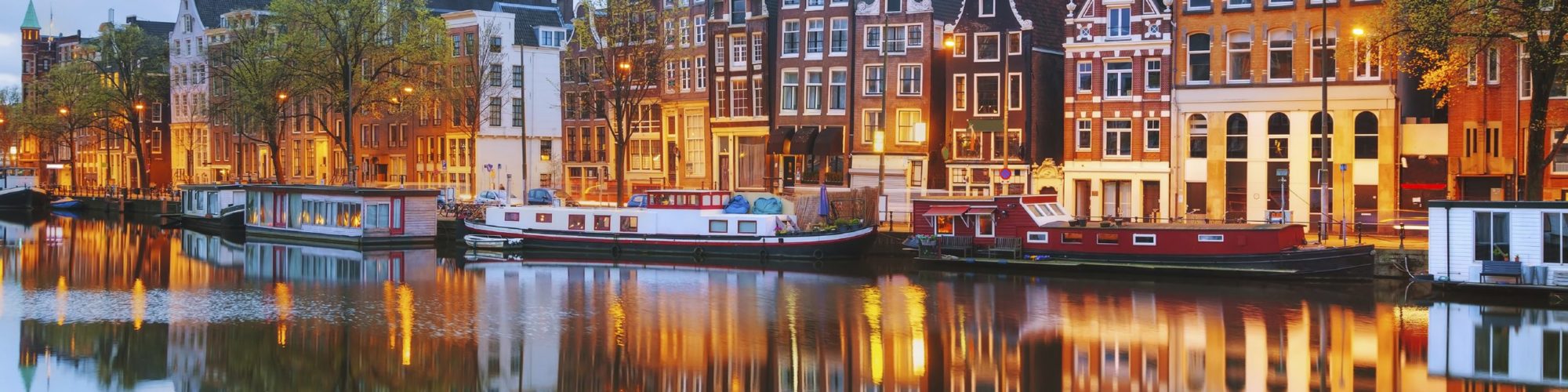
Amsterdam, for example, has lovely gabled houses, priceless paintings and cheery, multilingual people. It also has coffee shops selling cannabis and window prostitutes touting their wares. The Dutch are nothing if not practical about sensual needs and desires, and the Netherlands is as well-known for its tolerance as for its tulips.
Geography
Water defines life in the Netherlands. Because so much of the country is below sea level, Dutch life depends on 1,500 mi/2,400 km of dikes. (One-fifth of the nation is built on reclaimed lands.) The average elevation is 37 ft/11 m, and the only true hills are in the southeastern corner of the country. The Netherlands is bordered by Germany, Belgium and the North Sea. History
The Netherlands' broad and urbane tastes stem from its history as one of Europe's major trade and transportation centers. The present-day Netherlands didn't become a formidable power until the late 16th century, when Dutch explorers and merchants brought back valuable commodities from around the world and greatly increased the nation's wealth. The Dutch East India Company established a network of trade that included western Africa, the Cape of Good Hope (in present-day South Africa), India and the Spice Islands (in present-day Indonesia). Buoyed by its wealth and status, the Netherlands experienced a Golden Age (1580-1740) during which the arts flourished. Such extraordinary painters as Rembrandt, Vermeer and Frans Hals enjoyed the bounty of their country's heyday.
The Netherlands' status as a world power began to erode in the late 18th century and finally came to an end when the French invaded in 1795. After Napoleon's collapse in 1814, the Netherlands united with Belgium and Luxembourg to form the Kingdom of the Netherlands, although Belgium and Luxembourg later separated from the union and became independent. The Dutch remained neutral through many European conflicts, but they couldn't avoid World War II: Germany bombed Rotterdam to ashes in 1940 and occupied the country for the next five years. Dutch Jews were especially devastated, even by the Holocaust's cruel standards: Less than 20% survived the war.
After the war, the Netherlands emerged as one of the most socially progressive countries in Europe, passing laws to protect the homeless, and legalizing gay marriage, euthanasia and the use of some recreational drugs. As part of a recent and controversial law designed to help immigrants integrate into Dutch society, Dutch language classes are now mandatory for most newcomers. The Netherlands is a member of the European Union and home of the United Nations' International Court.
Snapshot
The Netherlands' main attractions include museums, historical sites, contemporary culture, Amsterdam, windmills, cheese, dikes, shopping, tulips and other flowers, castles and palaces, art, bicycling, cruises on canals, festivals and diamonds.
The Netherlands' appeal is universal, and ultratolerant Amsterdam is especially attractive to young people. But don't go looking for mountains or good beaches (there are far better stretches of sand elsewhere in Europe).
Potpourri
On 1 January 1986, the Netherlands officially got bigger, not by annexing land from its neighbors, but by actually growing. New land was reclaimed from the sea in one of the country's largest hydraulic engineering projects in the 20th century. The land was used for the 12th and newest province of Flevoland.
In 1670, the Dutch traded New Amsterdam—it's called New York City today—to the British for Suriname.
The Amsterdam Hilton was the site of John Lennon's and Yoko Ono's 1969 "Bed-In for Peace." The couple checked into one of the hotel's suites, removed all of the furniture except for the bed and then called a press conference protesting the Vietnam War. The room is now a luxury suite with decorations that memorialize the event.
Confused about the capital of the Netherlands? Amsterdam is the official capital, but the queen, the Parliament and most of the ministries reside and work in The Hague, the seat of government. Most foreign embassies are located there as well.
The tulip actually arrived from Turkey in the 17th century.
A country that is about the size of the U.S. state of Maryland, the Netherlands boasts a disproportionate amount of world-class art. There are more than 1,000 museums in the country, 50 in Amsterdam alone, exhibiting the works of some of the most famous artists in history.
You may notice what appear to be rearview mirrors outside canal-house windows. The mirrors allow residents to see who is knocking on the front door before they climb down the steep staircases.
Most canal houses had to be the same width, so the only way for their owners to distinguish their homes (and show their wealth) was to add a gable to the roofline. Some of the more popular types and shapes you'll see are bell, step and French gables.
Flooding is extensively used for security purposes; some 80% of the Netherlands' gold is kept below canal level so it can be flooded if thieves threaten.
If a car rolls into a canal, there's a hefty fee for pulling it out. If a person is in the car, however, there's no charge because it's a rescue mission. People have been known to jump into their cars as they roll toward a canal.
The population of the Netherlands is the tallest in the world, with an average height of 6 ft/1.83 m for adult males and 5 ft 7 in/1.7 m for adult females. The average American is 2.5 in/6.5 cm shorter than the average Dutchie.